

You’ve just picked up your dubai rental car, the GPS is set for Abu Dhabi, and you’re ready to hit Sheikh Zayed Road. Then someone mentions Salik. And Darb. And something about a 5% VAT that started in June. Suddenly the easy drive you planned feels like a toll math exam — and that’s exactly why the salik vs darb uae travel question trips up so many first-time visitors.
Here’s the honest version: both systems are simpler than they sound, and once you get the salik vs darb difference straight in your head, the whole UAE road trip gets cheaper and a lot less stressful. We’ve put this guide together for the actual traveller — the one behind the wheel, not the policy wonk — so you can skip the 3,000-word Wikipedia version and just figure out what you owe, where, and when. If you’re hunting for a clean salik vs darb breakdown, this is the version we wish we’d had on our first Dubai-to-Abu Dhabi drive.
Quick Answer: Salik vs Darb in 30 Seconds
Salik is Dubai’s toll system. Darb is Abu Dhabi’s. They don’t talk to each other. You’ll hit Salik gates as you move around Dubai, and Darb gates as you cross into Abu Dhabi. Both are cashless, both run about AED 4 a pop, but the rules around peak hours, free hours, and caps are completely different. Here’s the side-by-side so you can stop reading and start driving:
| What you actually care about | Salik (Dubai) | Darb (Abu Dhabi) |
| Where it works | 9 gates across Dubai | 4 gates into Abu Dhabi |
| How it sees your car | RFID sticker on windshield | Camera reads your plate |
| Cost per crossing | AED 4 off-peak · AED 6 peak | AED 4 (peak hours only) |
| Peak hours | 6–10 AM & 4–8 PM, Mon–Sat | 7–9 AM & 5–7 PM, Mon–Sat |
| When it’s free | 1 AM – 6 AM daily | All non-peak hours + all day Sunday |
| Daily cap | None — every crossing counts | None (cap removed in 2024) |
| What you need | Active Salik account + tag | Active Darb account + plate registered |
If you’re in a dubai rental car, you usually don’t have to do anything — the rental company pre-registers both systems on the fleet, and you settle up at the end. But knowing the table above helps you plan a cheaper trip, and that’s where the real savings live.

Table of Contents
What Salik Actually Is (and Why It Doesn’t Slow You Down)
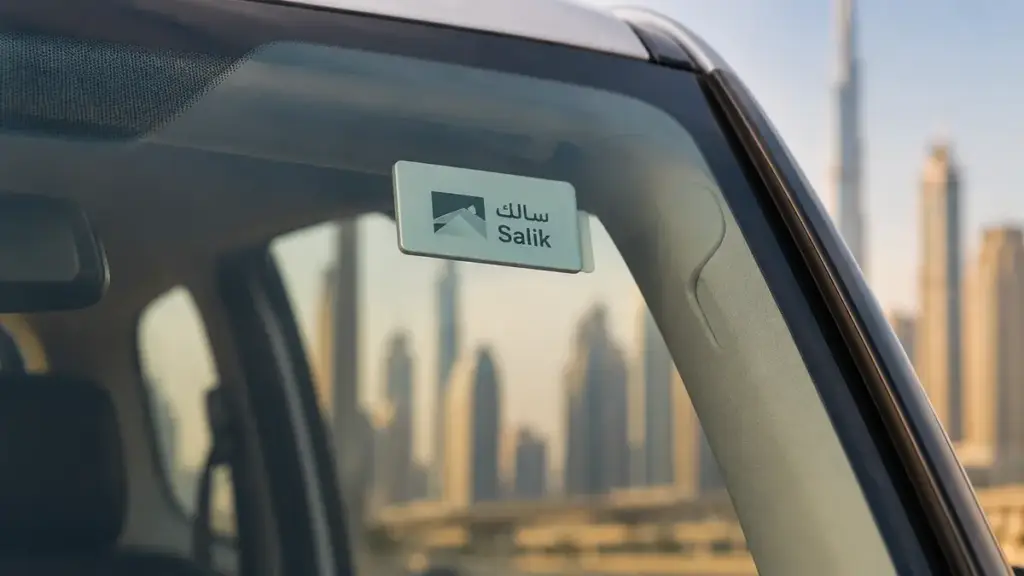
Salik means “open” or “clear” in Arabic, which is a nice way of saying you don’t have to stop. It’s the Salik toll Dubai system, launched back in 2007 and now run by Salik Company PJSC. You stick a thin RFID tag on your windshield, and every time you drive under one of the nine Salik gates scattered across the city, the gantry reads the tag and quietly deducts the toll from your prepaid account. No booth, no coins, no waving at anyone.
For a full walkthrough of how the account works and how to top it up, our What Is Salik in Dubai? guide goes deeper.
Which Roads Have Salik Toll Gates?
The gates sit on the busiest arteries — Sheikh Zayed Road, Al Ittihad Street, around Dubai International Airport, Al Garhoud Bridge, Al Maktoum Bridge, Al Safa (North and South), Al Mamzar (North and South), Al Barsha, Jebel Ali, and the newer Business Bay Crossing and Al Shindagha gates added in late 2024. So if you’re driving pretty much anywhere central in Dubai, you’ll cross at least one.
Salik Toll Charges, Peak Hours & VAT
Pricing-wise, Salik moved to variable rates on January 31, 2025. Off-peak crossings are AED 4, peak crossings are AED 6 (those peak windows are 6–10 AM and 4–8 PM, Monday to Saturday), Sundays and public holidays sit at a flat AED 4 all day, and the system goes completely free between 1 AM and 6 AM. Since June 1, 2026, a 5% VAT gets added on top — so the real numbers you’ll see on your statement are AED 4.20 and AED 6.30.
We dig into the timing side of things, including how to dodge the peak surcharge, in our Salik timing in Dubai: free hours, peak rates & tips piece.
Darb Toll System: How Abu Dhabi Differs from Dubai
Darb showed up later — January 2021 — under Abu Dhabi’s Law No. 17 of 2017. It’s the Darb toll Abu Dhabi system, and the big difference from Salik is right up front: there is no sticker, no tag, nothing on your car. The system uses overhead cameras with License Plate Recognition (LPR) technology. You just drive under the gate, the camera reads your plate, and the toll comes out of your Darb wallet.
Darb runs four gates right now, all of them on the bridges that connect Abu Dhabi island to the mainland: Sheikh Zayed Bridge, Sheikh Khalifa Bridge, Mussafah Bridge, and Al Maqta Bridge. If you’re coming from Dubai on the E11, you’ll most likely cross one of these — usually Sheikh Zayed Bridge if you’re heading into the city centre.
Darb Toll Hours: When You’ll Pay
Darb only charges during peak hours. Those windows are 7–9 AM and 5–7 PM, Monday to Saturday. Outside those hours, and all day Sunday and on public holidays, the gates are basically decoration. You drive through, the camera snaps your plate, and nothing happens. That’s a real lever for trip planning — more on that in the cost section below.
Darb Fines
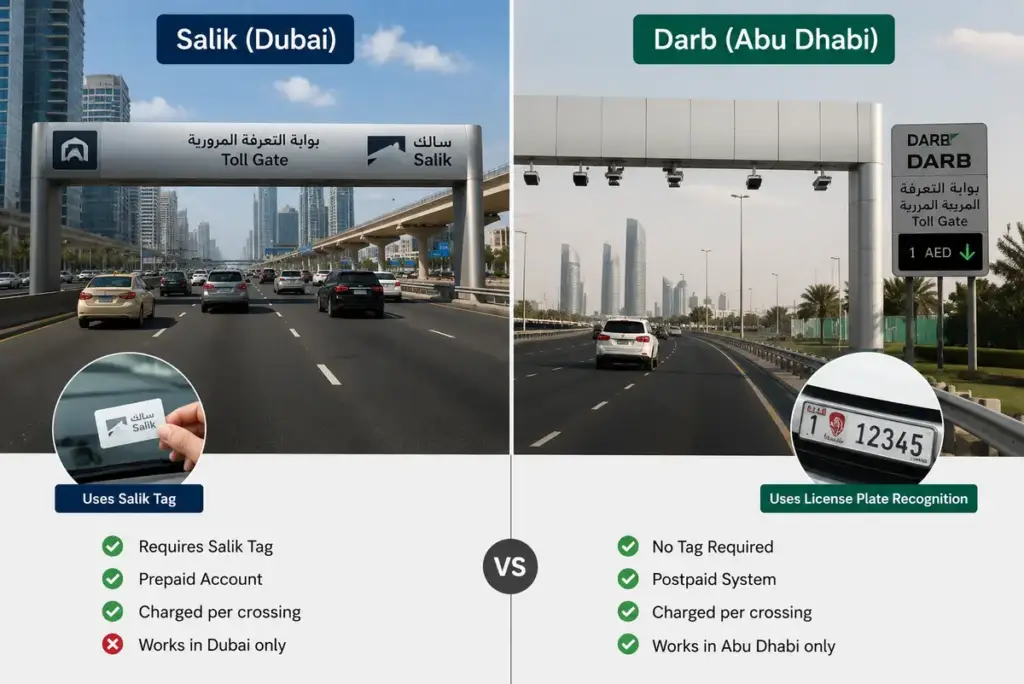
One important change to flag: Darb used to cap daily charges at AED 16 per vehicle and monthly charges at AED 200. Both caps were removed in late 2024. If you read an older guide that mentions the AED 16 cap, that guide is wrong now. Every peak-hour crossing is charged individually, full stop. If you cross a Darb gate without a registered account, you get a 10-working-day grace period to download the Darb app, register your plate, and settle up before a violation fine lands on you.
Salik vs Darb: 7 Differences That Actually Hit Your Wallet
Both systems are cashless. Both charge about AED 4 per crossing. Both use overhead gantries. From the outside they look interchangeable, and that’s exactly where most comparison articles stop. But for someone actually driving across the UAE, the seven differences below are the ones that change what you pay at the end of the month. This is the salik vs darb breakdown that matters on the road, not on a policy deck.
1. Where Each System Lives
Salik is Dubai-only. Darb is Abu Dhabi-only. They don’t share gates, they don’t share revenue, and there’s no overlap zone. The Salik gates Dubai network covers the city’s main arteries; the Darb gates Abu Dhabi system covers the four bridges onto the island. Drive from Dubai to Abu Dhabi and you’ll use Salik on the way out and Darb on the way in — two completely separate systems on a single trip.
2. How Your Car Gets Identified
Salik wants a physical RFID sticker on your windshield. The sticker itself costs AED 102.5 at any Emarat, ENOC, or EPPCO petrol station (or AED 122.5 online, both include a AED 50 prepaid credit). Darb doesn’t want anything on your car at all — it just wants your plate number registered to a Darb account in the app. That’s why a Dubai car with a Salik tag still needs a separate Darb registration to legally cross into Abu Dhabi during peak hours.
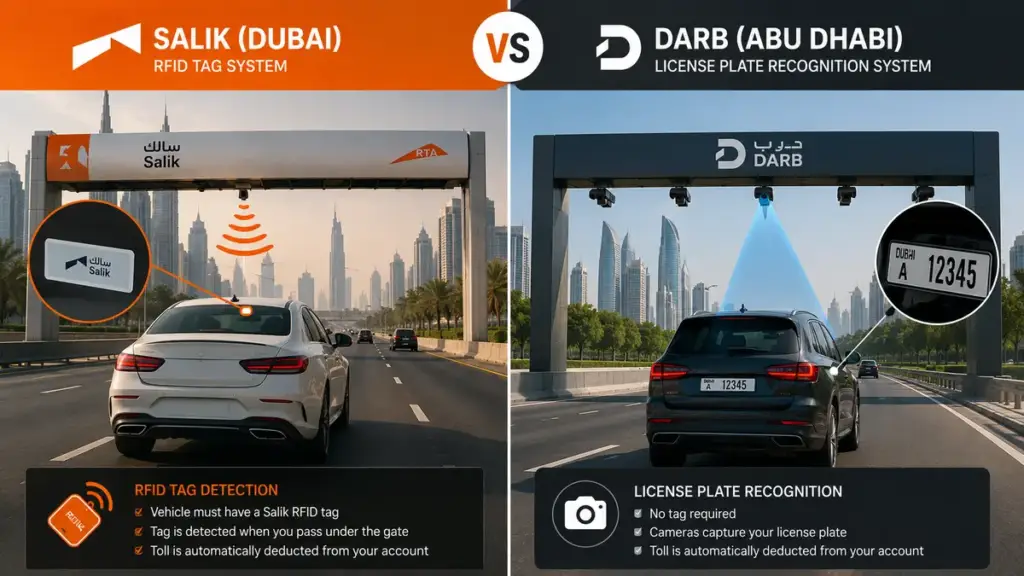
3. Peak vs Off-Peak Pricing
Salik moved to dynamic pricing in early 2025. AED 6 at peak, AED 4 off-peak, plus the 5% VAT that kicked in June 2026. Salik peak hours run 6–10 AM and 4–8 PM on weekdays. Darb has a simpler model: AED 4 flat during Darb peak hours, nothing outside peak. So while Salik’s peak rate is actually higher than Darb’s, Darb’s “free if you time it right” rule is the better lever if your schedule is flexible.
4. Free Hours and Sundays
Salik is only free between 1 AM and 6 AM — useful for night owls and shift workers, less so for tourists. On Sundays and public holidays, it stays on but drops to the flat AED 4 rate. Darb is the generous one: free outside peak hours every single weekday, free all day Sunday, free on public holidays. A Sunday morning run from Dubai to Abu Dhabi can skip Darb entirely and only pay the Sunday flat Salik rate.
5. Daily and Monthly Caps
Salik has never had a cap. Cross the same gate ten times in a day, pay ten times. Darb used to cap you at AED 16 per day and AED 200 per month — those caps were removed in late 2024. So neither system protects you from yourself anymore. The good news is that for a typical traveller crossing 2–4 gates per day, caps wouldn’t have kicked in anyway.
6. Registration: Who, What, When
Salik needs an active account with a positive balance and a tag on the car. Buy the tag, stick it on, top up the wallet, drive. Darb needs an active Darb account with your plate registered and a positive wallet balance. Download the Darb app (iOS or Android), create the account, add your plate, add funds. The registration fee is AED 100, of which AED 50 lands back in your wallet as prepaid credit. If you’re driving a dubai rental car, the rental fleet is already registered with both — you do nothing.
7. Penalties and the Grace Period
Salik is unforgiving: if your balance is too low when you cross, you get a short top-up window (about 5 working days) before a fine is generated. No grace, no second chances. Darb is gentler for first-timers: 10 working days to register on the app and settle the outstanding toll before a violation fine is added under Abu Dhabi’s toll executive regulations. Rental cars almost never trigger either penalty because the rental company keeps both accounts funded.
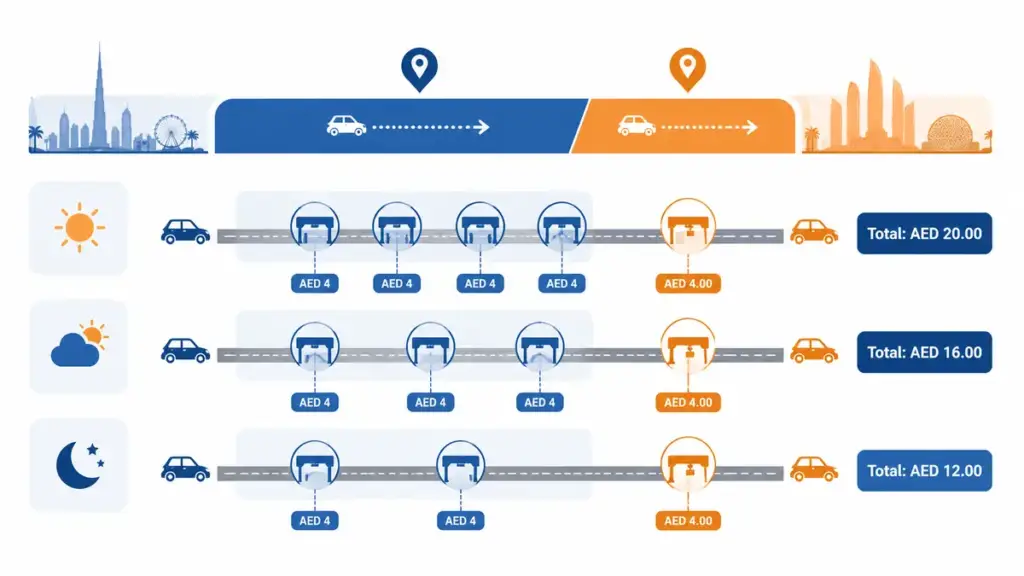
Real Numbers: What a Dubai–Abu Dhabi Trip Actually Costs
Let’s get concrete. You’re driving from Downtown Dubai — say, around Bur Dubai — to Abu Dhabi city centre on a weekday. The most common route puts you through one or two Salik gates in Dubai (usually Al Garhoud or Al Safa) and one Darb gate as you cross into Abu Dhabi (usually Sheikh Zayed Bridge). This is the classic Dubai to Abu Dhabi toll scenario, and here’s what that one-way trip costs in three different scenarios:
| When you leave | Salik (Dubai portion) | Darb (Abu Dhabi entry) | Total one-way |
| Weekday, 8 AM (peak) | AED 12.60 (2 gates × AED 6.30 incl. VAT) | AED 4.00 (peak hour) | AED 16.60 |
| Weekday, 11 AM (off-peak) | AED 8.40 (2 gates × AED 4.20 incl. VAT) | AED 0 (off-peak, free) | AED 8.40 |
| Sunday, any time | AED 8.40 (2 gates × AED 4.20 flat) | AED 0 (Sunday, free) | AED 8.40 |
Same trip. Same route. Same car. Almost a 2x difference in price depending on when you leave. Round-trip it and you’re looking at AED 32+ at peak vs AED 16–17 if you slide your departure by a couple of hours. That’s lunch money for two people, every single trip, just for picking a smarter time to drive. Multiply by a week of commuting and the savings become hard to ignore. The UAE toll cost math really does reward flexible schedules.
The single best toll-saving move for a UAE traveller is simple: leave before 7 AM or after 9 AM on weekdays, and aim for Sundays whenever the itinerary allows.
Salik, Darb, and Your Rental Car: Who Actually Pays?
For most people reading this, the rental car is the lens through which both Salik and Darb get experienced. The Salik rental car billing question is the one that actually shows up on your final invoice, so it’s worth getting right. The good news is genuinely good: every mainstream rental company in the UAE — whether you went with Hertz, Avis, Budget, or one of the local specialists — has its entire fleet pre-registered with both Salik (tag already on the windshield) and Darb (plate already in the company’s Darb master account). You don’t need to register anything yourself, top up any wallet, or fiddle with apps before you drive.
Here’s how the billing actually flows. When you cross a Salik or Darb gate, the toll lands on the rental company’s master account in real time. At the end of your rental period, the company reconciles every crossing against your rental dates, adds the total to your final invoice, and charges your card. Simple. Predictable. Mostly transparent — until you read the fine print about admin fees.
The Admin Fee Trap Nobody Warns You About
The actual toll is rarely the only thing on your invoice. Most rental companies add an administrative fee on top of every individual toll — usually somewhere between AED 5 and AED 15 per crossing. The fee covers the rental company’s cost of running the Salik and Darb accounts on your behalf, processing the data, and putting it on your invoice. It’s a real cost, and it’s standard practice across the industry.
Here’s where it stings: over a one-week rental with daily Dubai-to-Abu Dhabi commuting, the admin fees can easily exceed the actual tolls. A trip that costs AED 16.60 in real tolls might end up billed as AED 50+ once admin fees stack on every crossing. We break this down — including how to read the invoice, how to dispute overcharges, and what to ask at the counter — in our complete Who Pays Salik for Rental Cars in Dubai? guide. Short version: read the rental agreement’s toll section before you sign, and ask the counter staff this exact question: “What’s your per-toll admin fee, and is there a daily flat-rate option?”
Do I Really Need Both Salik and Darb Accounts?
This is the question that comes up on every UAE travel forum, and the Salik and Darb difference boils down to one practical answer that depends entirely on whose car you’re driving.
If you’re in a rental car — no. You don’t need to register for either. The rental company handles both. You just drive, and the charges show up on your final invoice. Many tourists never even realise they crossed toll gates until they see the line item on the return paperwork.
If you’re driving your own car (or a company car) across emirates — yes, you need both. Salik handles Dubai, Darb handles Abu Dhabi, and there is no shared account, no interoperability, and no way to pay one with the other’s wallet. They are run by completely separate operators (Salik Company PJSC and Abu Dhabi Mobility), on completely different technology stacks. A Dubai resident who occasionally drives down to Abu Dhabi needs a Salik tag on the windshield and a Darb account linked to their plate. An Abu Dhabi resident heading up to Dubai needs the mirror image.
If you’re only driving inside one emirate, you only need that emirate’s system. A tourist who never leaves Dubai never needs Darb. A tourist who flies into Abu Dhabi and never leaves the capital never needs Salik. The complexity only kicks in when you cross the emirate border — which, on a typical UAE holiday, you almost certainly will.
7 Quick Wins to Cut Your UAE Toll Bill
None of these are hacks. They’re just pattern recognitions — the kind of thing locals do automatically and tourists learn the expensive way. If you take one thing away from this salik vs darb guide, let it be the off-peak timing trick.
- Travel on Sundays when you can. Darb is free all day Sunday, and Salik drops to its flat AED 4 rate (no peak surcharge). One simple calendar choice can halve your toll spend.
- Aim for off-peak windows. Skip the 7–9 AM and 5–7 PM Darb peaks, and the 6–10 AM and 4–8 PM Salik peaks. Even a 30-minute shift in your departure can save AED 4 per gate.
- Use the Darb app to check your balance before you fly home. Unsettled charges follow you back to your home country and may be deducted from your rental deposit — sometimes with extra fees attached.
- Ask your rental company about a flat-rate toll package. Some operators offer unlimited Salik and Darb for a fixed weekly fee — often cheaper than per-crossing admin fees if you’re driving daily.
- Pick a route that avoids peak Salik gates. The Al Garhoud and Al Safa gates get hit by almost every central Dubai route, but alternative crossings through Business Bay or Al Mamzar can sometimes skip a gate or two.
- Top up your Salik wallet before it hits zero. Salik doesn’t forgive — once the balance is too low at the moment of crossing, a fine starts ticking. Auto-reload through the Salik app is the safest move.
- If you’re a GCC resident driving your own car into Abu Dhabi for the first time, register on the Darb app before you cross. The 10-day grace period is real, but why risk the fine when registration takes 10 minutes?
FAQ: Salik vs Darb for UAE Travel
The questions below come straight out of Google’s People Also Ask box and the most-asked threads on r/dubai. Short, direct answers — no fluff. If you’re scanning this salik vs darb guide on your phone in the rental car carpark, these are the quick hits.
Yes, but in practice the rental company handles both for you. Salik covers Dubai gates, Darb covers Abu Dhabi gates, and the two systems don’t talk to each other. If you’re driving a rental, both accounts are already set up on the fleet — you just pay the bill at the end. If you’re driving your own car, you need to register for both separately.
No. Salik tags only work at Salik gates in Dubai. Abu Dhabi’s Darb system uses license plate cameras, not RFID tags, so a Salik sticker on your windshield means nothing to a Darb gate. If you drive a Salik-tagged car through a Darb gate, the camera reads your plate and you need to register on the Darb app within 10 working days to settle the charge.
Yes. Darb is free all day on Sundays and public holidays, and also free outside peak hours (7–9 AM and 5–7 PM, Monday to Saturday) on regular weekdays. If your schedule is flexible, a Sunday trip from Dubai to Abu Dhabi can dodge Darb entirely — you’ll only pay the Sunday flat Salik rate on the Dubai portion.
It depends on your route and departure time. A typical one-way trip from central Dubai to central Abu Dhabi crosses 1–2 Salik gates (AED 4–6 each, plus 5% VAT from June 2026) and 1 Darb gate (AED 4 at peak, free off-peak). Realistic total: AED 12–18 at peak, AED 8–9 off-peak or on Sunday. Round trip it for the full picture. This is the most common salik vs darb uae travel cost question, and the answer is almost always “less than you think, if you time it right.”
Yes — almost every rental car in the UAE comes pre-registered with both. Salik tags are physically on the windshield, and Darb accounts are tied to the rental fleet’s plates. You don’t have to do anything except drive. The charges land on your final invoice, plus an admin fee per toll (typically AED 5–15). Always check the rental agreement for the exact admin fee structure.
If you’re driving a rental car, you don’t need to — the rental company’s Darb account covers you. If you’re driving your own (non-rental) car, download the Darb app (iOS or Android), create an account, add your plate number and a payment method, and pay the AED 100 registration fee (AED 50 of which becomes prepaid wallet credit). The whole process takes about 10 minutes.
The 5-Second Cheat Sheet (Save This Before You Drive)
If you only remember five things about Salik vs Darb as a UAE traveller: 1. Salik = Dubai. Darb = Abu Dhabi. Separate accounts, no overlap. 2. Rental cars already have both. You do nothing except pay the invoice. 3. Darb is free outside 7–9 AM and 5–7 PM on weekdays, and free all day Sunday. 4. Salik is free 1–6 AM daily; Sundays are flat AED 4 (no peak). 5. Always ask your rental company: “What’s your per-toll admin fee?”
The Bottom Line
There’s no “winner” between Salik and Darb — they cover different emirates, they run on different tech, and you can’t substitute one for the other. The traveller’s job isn’t to pick a side; it’s to understand both well enough to plan a cheaper, smoother trip. If you came in asking the salik vs darb uae travel question, the short answer is: you’ll use both, the rental company handles both, and the only real lever you have is timing your drive around Darb’s free hours and Salik’s off-peak windows.
If you’re renting, do nothing. The rental company has both systems wired up, and your only real lever is asking about the admin fee structure before you sign. If you’re driving your own car across emirates, register for both Salik and Darb before the trip, top up both wallets, and time your Abu Dhabi arrivals around Darb’s free hours. That’s the whole game.