


The UAE Ministry of Interior (MOI) keeps a free public page that shows the accident record attached to a vehicle’s chassis number. Used-car buyers lean on it before committing to a purchase, and it takes about two minutes once you have the number.
The service sits on the MOI e-services portal under the plain name Accidents Inquiry. There is no account to create and nothing to pay. You enter the chassis number, solve a captcha and read the result.
One detail belongs near the top rather than buried further down: the database behind the lookup does not include Dubai records, so a Dubai-registered car is checked through RTA or Dubai Police instead. The exact steps, the result fields and the limits of a clean result are all covered below.
QUICK ANSWER
The MOI Accidents Inquiry page is free and open to everyone: no UAE Pass, no Emirates ID, no account. You need the vehicle’s chassis number, which is its 17-character VIN, printed on the registration card. The result lists the reported accidents recorded against that chassis, each with a date, a time, a location and a police report number. The database covers vehicles registered in Abu Dhabi, Sharjah, Ajman, Umm Al Quwain, Ras Al Khaimah and Fujairah. A car registered in Dubai from day one returns no data, and an empty result is never proof of an accident-free car.
Table of Contents
What is MOI accident history, and why it matters
MOI accident history is the record of reported traffic accidents held against a vehicle’s chassis number in the system behind the Ministry of Interior portal. An entry appears only when police attended the scene and a report was filed, which is what makes the record useful: it is the car’s official past rather than the version presented at the viewing. Accident damage hides well under good paint, in a repaired frame, a patched-over airbag or suspension that never quite holds again, and those are the repairs that come back as costs. A two-minute free lookup prices that risk before it becomes the buyer’s problem.
Example. A seller advertises a 2019 Patrol as accident-free and holds firm on price. The inquiry returns two reported accidents, one carrying a Sharjah report number from 2021. The car may still be a fine buy, but it is no longer priced on the seller’s word alone.
Accident history, accident report, traffic file: three different things
People arrive at the MOI portal looking for three different things, and the portal keeps them in three different places. Knowing which one you want saves a round of confused clicking.
- Accident history: the list of reported accidents recorded against a chassis number. The MOI inquiry, EVG and the Abu Dhabi Police lookup all provide this, and it is the check that matters before buying a used car.
- An accident report: a document for one incident. Police issue it after a crash, insurers use it to settle claims, and a copy is reissued by the force that wrote it, usually for a fee.
- A traffic file: the driver’s own record of fines, black points and licence status. The MOI portal shows your own traffic file after login, which is a different screen from the public accident lookup.
This guide follows the first of the three, with the others appearing only where they help explain it.
How to run the MOI accident check
Find the chassis number
The chassis number is the vehicle’s VIN, a 17-character code that identifies the car rather than its owner. The back of a UAE registration card carries it, and the same number sits on the plate at the base of the windscreen on the driver’s side and on a sticker in the driver’s door jamb.
Type it exactly as printed. A single wrong character either throws an error or pulls up a different vehicle. And if a seller refuses to share the number, that refusal answers the whole transaction: no verification of any kind works without it.
Run the lookup
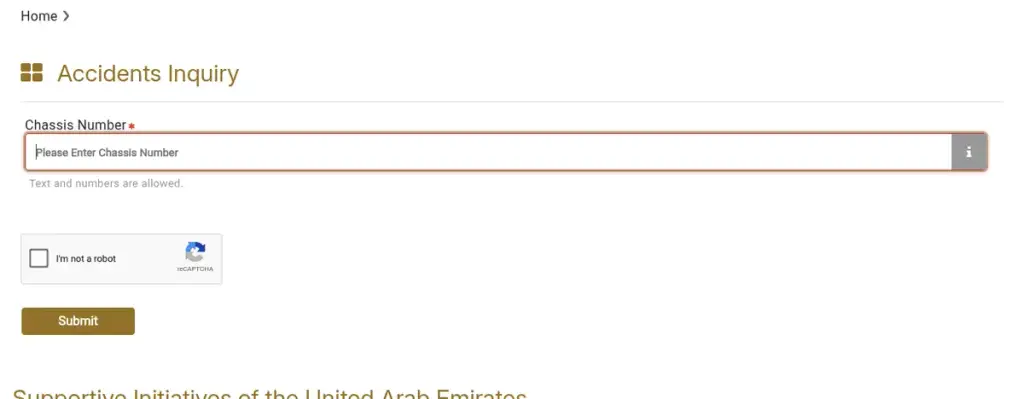
Open the MOI Accidents Inquiry page. The same screen sits in the portal’s services directory under Traffic Services. The form is one field and a captcha:
- Type or paste the chassis number into the single field. It accepts up to 20 characters.
- Solve the captcha and submit.
- Read the result.
Two errors come up regularly. The captcha refreshes after each failed attempt, so solve the new image instead of resubmitting the old answer. An invalid-chassis message nearly always means a mistyped character, and the usual culprits are O standing in for 0 or I for 1. Nothing in the flow asks for a login or a UAE Pass.
What the result looks like
For each reported accident, the inquiry returns a compact set of fields. This is what each one gives you:
| Field in the result | What it gives you |
| Accident date and time | When the incident was recorded |
| Location | Where police logged the accident |
| Accident report number | The reference tied to that incident’s police report |
| Number of accidents | How many reported accidents sit on the chassis |
The table describes the fields the service returns. It is an illustrative guide, not a sample of an official record.
The date tells you when. The report number is the more useful half: with it, you can ask the seller, or the police force that holds the report, for the full document, which is where severity and fault live. The count answers the question buyers ask first, which is how many.
The Dubai exception
Plenty of guides claim the MOI lookup covers all seven emirates. It does not, and the gap has a name: Dubai. The MOI portal and EVG draw on the federal traffic system, which holds records for vehicles registered in Abu Dhabi, Sharjah, Ajman, Umm Al Quwain, Ras Al Khaimah and Fujairah. Dubai keeps its vehicle records with Dubai Police and RTA, and they do not surface in the federal lookup.
In practice:
- A car registered in Dubai from day one returns no data on the MOI inquiry. An empty screen there means the vehicle sits outside the database, not that it has a clean history.
- A car first registered in another emirate keeps its earlier record on the MOI lookup even after a later transfer to Dubai. EVG loses the history at that point, so the two platforms can disagree about the same vehicle.
- An imported car enters the system at its first UAE registration, and nothing from before that moment appears.
For a Dubai-registered car the replacements are straightforward. RTA’s Technical Vehicle Status Certificate covers ownership history, insurance and accidents for the emirate, costs AED 120, and is ordered through rta.ae or the Dubai REST app with a UAE Pass login. Dubai Police also fields vehicle-record questions on its non-emergency line, 901.

What a clean result actually means
Zero records on the MOI inquiry means one precise thing: no police-reported accident is recorded against that chassis number in the federal system. It is not a certificate that the car has never been damaged.
Three common situations leave a record clean. Two drivers can settle a small accident between themselves without police involvement, and nothing reaches any database. Repairs paid in cash at a workshop, outside any insurance claim, leave the same silence. And an imported car starts its UAE record at first registration, so whatever happened abroad stays out of the result.
A clean record is still a good sign, and on a UAE-registered car with a few years on the road it is a meaningful one. Treat it as one green light among several. An independent inspection before purchase remains the only check that sees panels, structure and flood repairs.
An accident history is not a full vehicle history report
The MOI result answers one question well: has this chassis been in a reported crash? A purchase decision asks several more, and it helps to know which service answers which.
Severity is the largest gap. The summary does not grade accidents, so a parking knock and a substantial collision look identical in a list. Repair quality is invisible to every government database, because nothing records whether a rebuild used genuine parts or careful labour. Insurance claims stay with insurers, so a claims history has to be requested from the seller’s insurer rather than read off a portal. Ownership count and mileage, the other pillars of a full vehicle history report, come from the RTA certificate in Dubai or a paid history service elsewhere.
What the free lookup hands you is the skeleton: dates, places and report numbers. You add the rest by requesting the reports behind those numbers, asking for a claims statement and booking an inspection. Used together, the free checks and the paid paperwork cover most of what a buyer needs.
Which service for which car
Five official services deal with accidents, and they overlap less than people assume. Pick by where the car is registered rather than by which app is already installed.
| Service | What it holds | Login | Cost | Use it when |
| MOI Accidents Inquiry | Reported accidents for vehicles registered in the six emirates outside Dubai | None | Free | You have a chassis number and want the fastest free check |
| EVG | Accident history plus repair status, same six emirates | Account tied to a UAE traffic file | Free | You want accident detail and repair progress in one place |
| Abu Dhabi Police / TAMM | Accident history for Abu Dhabi-registered vehicles | None on the police site, UAE Pass on TAMM | Free | The car is registered in Abu Dhabi |
| Dubai Police | Reports for accidents that happened in Dubai | Account or UAE Pass | AED 100 plus AED 20 for a report copy | You hold a report number and need the document behind it |
| RTA vehicle status certificate | Ownership, insurance and accident history for Dubai-registered cars | UAE Pass | AED 120 | You are buying a car registered in Dubai |
The Abu Dhabi Police inquiry is public and captcha-based, like the MOI page, while TAMM’s View Vehicle Accident History covers the same ground behind a UAE Pass login, so the choice between them usually comes down to whether UAE Pass is already set up.
EVG registration asks for a traffic file number, an Emirates ID or unified number and a UAE mobile, verified by UAE Pass or a one-time code. Residents clear that bar in minutes, while buyers outside the UAE system get further with the MOI page, which asks for nothing but the chassis number and a captcha.
Fees for documents are revised from time to time. Treat the figures here as correct at the time of writing and confirm them on the official site before paying.
What to do after the check
The lookup itself takes minutes. Acting on it well takes a little longer. A short routine, in order:
- Match the chassis number on the registration card against the stamp on the car itself. A mismatch ends the conversation.
- Put every report number from the result to the seller. Someone who mentions one small incident against a record listing three now has something specific to explain.
- Ask for an insurance claims statement covering the seller’s ownership period. A clean database plus an empty claims file is a far stronger signal than either alone.
- Run a fines check on the vehicle while you are at it. Our guide to checking traffic fines in the UAE covers four ways to do it.
- Book an independent inspection at a recognised test centre before money changes hands. Structural damage, panel misalignment and flood repairs are exactly what no accident database records.
None of this needs to feel adversarial. Sellers with nothing to hide tend to warm to a buyer who does the work, and the ones who bristle at a chassis number or a claims request have told you something too.

FAQ about MOI accident history checks
Yes. The Accidents Inquiry page costs nothing, and the same goes for EVG’s accident history and the Abu Dhabi Police lookup. Money enters when you need documents: RTA’s vehicle status certificate is AED 120, and a Dubai Police report copy costs AED 100 plus AED 20 in knowledge and innovation fees. Check the current figure on the official site before paying.
No. The public accident check services key on the chassis number, and the plate-number services on the same portals deal with fines and registration, tied to the owner’s traffic file. The registration card carries the chassis number, and any seller can read it out in seconds.
Yes. The inquiry is public by design: no login, no ownership proof, no Emirates ID. Anyone with a chassis number can run it, which is also why the result stops at basic record details.
No. Police systems record accidents and insurers record claims, and the two meet only when a claim references a police report. EVG shows the status of repairs managed through its platform, but a full claims history has to come from the seller’s insurer.
Their UAE record starts at first local registration. Everything before that, whether a crash in Japan or an auction sale in the United States, stays outside the MOI and EVG databases. Commercial VIN history reports cover the pre-import period, at a cost and with varying quality, so pair one with a physical inspection rather than trusting it alone.
Yes. The MOI portal has an AR toggle in its header, and the Accidents Inquiry service works identically in Arabic. The result fields are the same.
