

Salik timing in Dubai has changed significantly over the past two years. On 31 January 2025, the old flat AED 4 rate was replaced with variable pricing that charges AED 6 during peak hours, AED 4 during off-peak hours, and nothing at all during a new overnight free window. Then on 1 June 2026, a 5% VAT was added on top of every crossing. For anyone who drives regularly in Dubai — commuters, residents, or tourists renting a car — knowing exactly when each rate applies is the single biggest lever for keeping your monthly toll bill under control.
This guide breaks down every Salik timing rule you need: the peak and off-peak windows, the daily free hours, the Sunday flat rate, the Ramadan shift, and the one-hour rule for paired gates. For the broader background on how the system works, see our complete guide on what Salik is in Dubai.
Quick Summary
Before we get into the details, here is a quick snapshot of the current Salik timing rules at a glance:
Quick Fact What You Need to Know Peak Hours 6:00 AM – 10:00 AM and 4:00 PM – 8:00 PM, Monday to Saturday — AED 6.30 with VAT Off-Peak Hours 10:00 AM – 4:00 PM and 8:00 PM – 1:00 AM, Monday to Saturday — AED 4.20 with VAT Free Hours 1:00 AM – 6:00 AM every day, all gates, no charge Sunday Rate Flat AED 4.20 with VAT all day, except the 1–6 AM free window Ramadan Peak 9:00 AM – 5:00 PM (AED 6.30); free window shifts to 2:00 AM – 7:00 AM One-Hour Rule Al Mamzar North + South and Al Safa North + South, charged once if crossed in the same direction within 60 minutes

Table of Contents
Salik Timing in Dubai at a Glance
Salik timing is built around three rate bands — peak, off-peak, and free — that apply across every toll gate in the city. The bands are the same Monday through Saturday, the schedule simplifies on Sundays, and the entire structure shifts during Ramadan. Below are the three quick-reference tables that cover every day of the year.
Daily Snapshot (Monday to Saturday)
| Time Window | Rate | With VAT |
| 06:00 AM – 10:00 AM (morning peak) | AED 6 | AED 6.30 |
| 10:00 AM – 04:00 PM (midday off-peak) | AED 4 | AED 4.20 |
| 04:00 PM – 08:00 PM (evening peak) | AED 6 | AED 6.30 |
| 08:00 PM – 01:00 AM (evening off-peak) | AED 4 | AED 4.20 |
| 01:00 AM – 06:00 AM (overnight free window) | Free | Free |
Sunday Timing Snapshot
| Time Window | Rate | With VAT |
| 06:00 AM – 01:00 AM (next day) | Flat AED 4 | AED 4.20 |
| 01:00 AM – 06:00 AM | Free | Free |
Ramadan Timing Snapshot (Monday to Saturday)
| Time Window | Rate | With VAT |
| 02:00 AM – 07:00 AM (Suhoor free window) | Free | Free |
| 07:00 AM – 09:00 AM (low-peak morning) | AED 4 | AED 4.20 |
| 09:00 AM – 05:00 PM (peak) | AED 6 | AED 6.30 |
| 05:00 PM – 02:00 AM (low-peak evening) | AED 4 | AED 4.20 |
Sundays during Ramadan keep the flat AED 4 rate, and the one-hour rule for paired gates still applies.
Salik Peak Hours
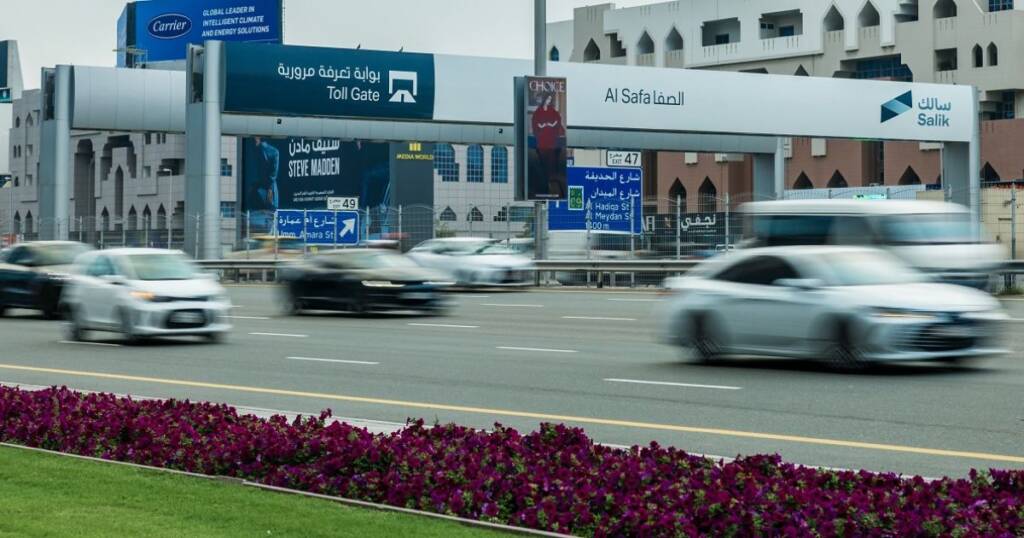
Peak hours are when most commuters are on the road, and Salik uses a higher toll to discourage non-essential trips. There are two peak windows every weekday, Monday through Saturday, and the rate is the same at every gate in Dubai — AED 6 per crossing, or AED 6.30 with VAT.
Morning Peak — 6:00 AM to 10:00 AM
The morning peak catches the inbound commute to DIFC, Downtown, Business Bay, and Dubai Marina. It is the most expensive window of the day for a single crossing, and it is also the busiest — so you pay more and you sit in traffic longer. If your job allows flexible hours, shifting your departure by even 20 to 30 minutes can drop you into the off-peak window and save you AED 2.10 per crossing.
Evening Peak — 4:00 PM to 8:00 PM
The evening peak mirrors the morning one and captures the outbound commute, the school run, dinner traffic, and the early wave of evening social trips. It tends to feel heavier than the morning peak because it overlaps with shopping mall traffic and tourist movement along Sheikh Zayed Road, particularly near Al Barsha and Al Safa gates.
The dynamic pricing model was introduced by the RTA to spread traffic more evenly across the day. Before 2025, Salik charged a flat AED 4 regardless of when you drove, which gave drivers no incentive to avoid rush hour. By charging 50% more during peak hours and offering a free overnight window, the system nudges discretionary trips into less congested times.

Salik Off-Peak Hours
Off-peak hours are the budget-friendly windows for anyone who can be flexible with their schedule. The toll drops to AED 4 (AED 4.20 with VAT), which is a 33% saving compared to peak hours.
Midday Off-Peak — 10:00 AM to 4:00 PM
The midday window is the quietest stretch of the Dubai driving day, with lighter traffic on Sheikh Zayed Road and easier parking at most destinations. If you work from home, run a business with flexible hours, or are simply visiting the city as a tourist, scheduling your trips between 10 AM and 4 PM is the single easiest way to cut your monthly Salik bill.
Evening Off-Peak — 8:00 PM to 1:00 AM
The evening off-peak window starts at 8 PM and runs until 1 AM. It covers late dinner runs, night shifts, airport pickups on late flights, and the post-traffic wave of social trips. The toll is AED 4.20 with VAT for the entire window, and then it drops to free at 1 AM.
Salik Free Hours in Dubai (1:00 AM – 6:00 AM)
The biggest pricing change in the 2025 update was the introduction of a true free window. From 1:00 AM to 6:00 AM, seven days a week, no toll is charged at any of the ten Salik gates in Dubai. The free window is the same on weekdays, weekends, and public holidays — there is no day of the year when the 1 AM to 6 AM window does not apply.
Al Maktoum Bridge — The Extra Free Window You Should Know
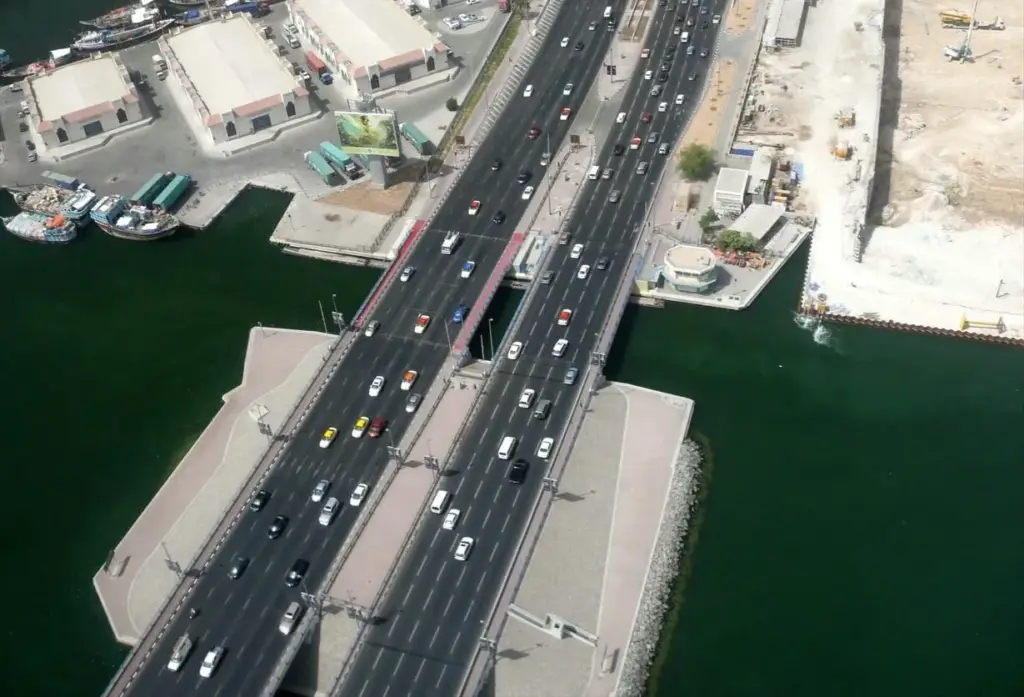
Al Maktoum Bridge is the one gate in Dubai with a special historical rule that still works in your favour. In addition to the daily 1 AM to 6 AM free window, Al Maktoum Bridge is also free from 10 PM to 6 AM on weekdays, and it is free all day on Sundays. If your route takes you between Deira and Bur Dubai, you can save a crossing by timing your trip after 10 PM on a weeknight or any time on a Sunday.
You do not have to become a night-shift driver to benefit from the free window. The trick is to identify trips that already happen late or can be moved without much pain. Late-night airport runs, early-morning airport drop-offs for flights between 3 AM and 7 AM, post-midnight food runs, and weekend late-night social visits all fall naturally inside the free block. Even one or two crossings inside the free window per week can save you AED 20 to AED 40 per month
.
Sunday Salik Timing — Flat AED 4 Rate
Sundays are the most relaxed day on the Salik calendar. Instead of the usual peak and off-peak split, the system applies a flat AED 4 rate (AED 4.20 with VAT) for the entire chargeable window from 6 AM to 1 AM. The 1 AM to 6 AM free window still applies on Sundays — so if you are driving home from a Saturday night out and you cross a Salik gate at 2 AM on Sunday morning, the crossing is free.
Traffic volumes on Sundays are significantly lower than Monday to Saturday, particularly in the morning and evening peaks. The RTA uses the flat AED 4 rate as a soft incentive for drivers to move non-essential trips — grocery runs, family visits, mall trips — to Sundays. If you have a trip that does not have to happen on a weekday, doing it on Sunday saves you AED 2.10 per peak-hour crossing.
Public holidays are not automatically treated as Sundays. A public holiday that falls on a weekday usually follows the regular Monday-to-Saturday peak and off-peak schedule, unless Salik specifically announces a holiday exception. Always check the official Salik announcement before driving on the first or last day of a public holiday period, particularly for Eid Al Fitr and Eid Al Adha.
Salik Timing During Ramadan
Ramadan reshapes the entire Dubai daily rhythm, and Salik timing shifts with it. The schedule is different from the rest of the year, and the changes are significant enough that even experienced Dubai drivers need to recheck the table at the start of each holy month.
During Ramadan, the peak window moves to the middle of the day — from 9:00 AM to 5:00 PM, at the AED 6 rate (AED 6.30 with VAT). This single eight-hour block captures the shortened working day, when most office workers are commuting and most businesses are operating between Fajr prayer and Iftar. It covers the pre-Iftar rush as people head home or to restaurants.
The off-peak windows during Ramadan run from 7:00 AM to 9:00 AM in the morning and from 5:00 PM to 2:00 AM in the evening and night, both at the AED 4 rate (AED 4.20 with VAT). The evening low-peak is much longer than the regular schedule, running from Iftar time all the way to 2 AM, which suits the post-Taraweeh social rhythm of Ramadan nights.
The free window during Ramadan shifts by one hour. Instead of 1 AM to 6 AM, the free block runs from 2:00 AM to 7:00 AM, which covers Suhoor travel for those observing the fast. Sundays during Ramadan keep the flat AED 4 rate that applies the rest of the year, and the one-hour rule for paired gates is not suspended.
VAT on Salik Tolls
Since 1 June 2026, Salik applies 5% VAT on every toll transaction and on tag activation fees. The peak-hour crossing is now AED 6.30 (previously AED 6), the off-peak and Sunday crossings are AED 4.20 (previously AED 4), and the overnight free window remains completely free. Existing tag holders do not need to do anything — the VAT is calculated automatically on each crossing and shown on your Salik account statement. For a full breakdown of Salik costs, fees, and tag pricing, see our dedicated guide on what Salik is in Dubai.
The One-Hour Rule for Paired Gates
The one-hour rule is one of the most underused money-saving features in the Salik system. If you understand it, you can cut your toll bill on certain routes by 50% without changing your timing at all. The rule applies to two pairs of gates only: Al Mamzar North and Al Mamzar South (both on Al Ittihad Street, the Sharjah-to-Dubai corridor), and Al Safa North and Al Safa South (both on Sheikh Zayed Road, between Al Meydan Street and 1st Interchange).
If you cross both gates in a pair in the same direction within 60 minutes, you are charged only once. The clock starts at the first gate and ends when you cross the second one. The rule works in both directions and applies during peak, off-peak, and Ramadan schedules. The reason for the rule is simple: these gates are so close together that charging twice for a single trip would be unfair to drivers who have no realistic alternative route.
The rule is easy to lose if you are not paying attention. The most common mistake is taking too long between the two gates — a traffic jam, a wrong turn, or a quick stop for coffee can push the gap past 60 minutes and trigger a second charge. The second mistake is crossing the paired gates in opposite directions within an hour — the rule only applies when you are travelling in the same direction. And the rule does not apply to any other gate combination. Crossing Al Barsha and Jebel Ali within an hour, for example, will result in two charges.
How to Time Your Trip to Save on Salik
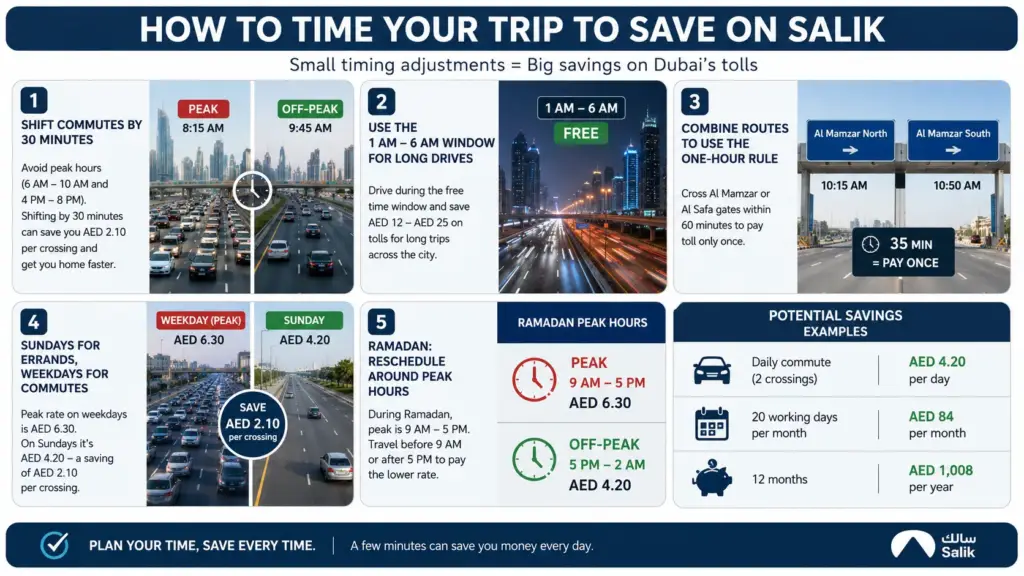
Saving on Salik is rarely about a single big decision. It is about a series of small timing adjustments that compound over weeks and months. Below are five tips that work for residents, commuters, and tourists alike.
Tip 1 — Shift Commutes by 30 Minutes
The single highest-leverage change you can make is to shift your commute by 30 minutes in either direction. If you usually leave home at 8:15 AM (peak), try 9:45 AM (off-peak). The same logic applies to the evening commute: leaving at 7:45 PM instead of 5:15 PM saves you the peak surcharge and usually gets you home faster because traffic is lighter.
Tip 2 — Use the 1 AM – 6 AM Window for Long Drives
If you have a long drive across the city — say, from Dubai Marina to Sharjah airport for an early flight, or from Downtown to Jebel Ali for a late-night delivery — try to schedule it inside the 1 AM to 6 AM free window. A single long trip in this window can save you AED 12 to AED 25 in tolls compared to the same trip during peak hours.
Tip 3 — Combine Routes to Use the One-Hour Rule
If your route takes you past Al Mamzar North and Al Mamzar South, or past Al Safa North and Al Safa South, plan your trip so both crossings happen inside the same 60-minute window. For Sharjah commuters this is essentially automatic — but if you ever take a detour between the two Al Mamzar gates, you will lose the discount.
Tip 4 — Sundays for Errands, Weekdays for Commutes
If you have a list of weekend errands that involve multiple toll gates — a trip to a specific mall, a visit to a friend across the city, a run to a specialist clinic — moving them from Saturday to Sunday cuts each peak-hour crossing from AED 6.30 to AED 4.20. For a four-crossing Saturday trip, that is a saving of AED 8.40 per trip.
Tip 5 — Ramadan: Reschedule Meetings Around 9 AM – 5 PM Peak
During Ramadan, the peak window shifts to 9 AM to 5 PM, which catches the shortened working day. If you can schedule meetings and site visits before 9 AM or after 5 PM, you drop into the off-peak rate and save AED 2.10 per crossing. The post-Iftar low-peak window (5 PM to 2 AM) is particularly useful for social visits and evening errands.
Common Mistakes with Salik Timing
Even experienced Dubai drivers slip up on Salik timing. Below are the four most common mistakes and how to avoid them.
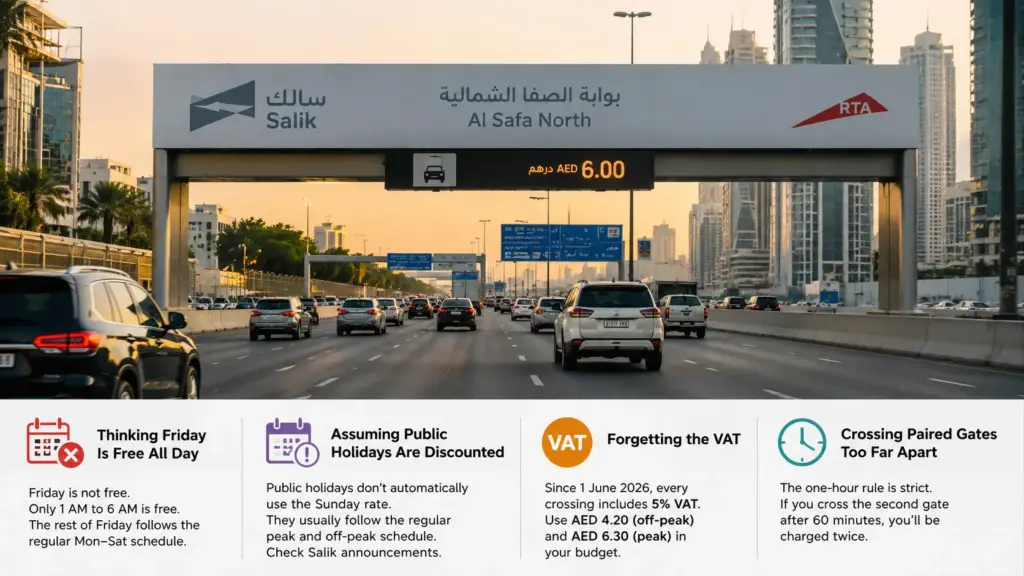
Thinking Friday Is Free All Day
Friday is not a free day on Salik. Only the 1 AM to 6 AM window is free, the same as every other day of the week. The rest of Friday follows the regular Monday-to-Saturday peak and off-peak schedule. This is a common misconception because Friday is the weekly holy day in the UAE — but Sunday is the discounted day in the Salik calendar, not Friday.
Assuming Public Holidays Automatically Use the Sunday Rate
Public holidays do not automatically use the Sunday flat rate. In most cases, public holidays that fall on a weekday use the regular peak and off-peak schedule. Salik has issued specific updates for some holidays (including Eid Al Adha and Eid Al Fitr) where peak rates applied even on a Sunday. Always check the official Salik announcement before driving on a public holiday.
Forgetting the VAT
Since 1 June 2026, every Salik crossing includes 5% VAT. If you are still budgeting based on the old AED 4 and AED 6 rates, your monthly estimate will be slightly off. Update your monthly budget with the VAT-inclusive rates (AED 4.20 and AED 6.30) to avoid surprises.
Crossing Paired Gates More Than One Hour Apart
The one-hour rule for Al Mamzar North + South and Al Safa North + South is strictly enforced. If you cross the first gate at 8:15 AM and the second gate at 9:20 AM, you will be charged twice — the gap is more than 60 minutes. Traffic jams on Al Ittihad Street are the most common cause of this mistake, so it is worth checking live traffic before you leave.
Salik Timing for Rental Car Customers
If you are renting a car in Dubai, the timing rules above apply to you exactly the same way they apply to car owners — the only extra layer is how the rental company bills you. For a full breakdown of how rental companies handle Salik billing and how to estimate your toll costs before you book, see our complete guide to Salik for rental cars in Dubai.
FAQ About Salik Timing in Dubai

When is Salik free in Dubai?
Salik is free every day from 1:00 AM to 6:00 AM at all ten toll gates in Dubai. During Ramadan, the free window shifts to 2:00 AM to 7:00 AM to cover Suhoor travel. Al Maktoum Bridge has an additional free window from 10 PM to 6 AM on weekdays and is free all day on Sundays.
What are Salik peak hours?
Salik peak hours run from 6:00 AM to 10:00 AM and from 4:00 PM to 8:00 PM, Monday to Saturday. During Ramadan, the peak window changes to a single block from 9:00 AM to 5:00 PM. Sundays do not have peak hours — they use a flat AED 4 rate for the entire chargeable window.
What are Salik off-peak hours?
Salik off-peak hours run from 10:00 AM to 4:00 PM and from 8:00 PM to 1:00 AM, Monday to Saturday. The toll during these windows is AED 4 per crossing (AED 4.20 with VAT). The overnight window from 1:00 AM to 6:00 AM is completely free.
Is Salik free on Sundays?
No, Salik is not free on Sundays (except for the 1 AM to 6 AM free window that applies every day). Sundays use a flat AED 4 rate (AED 4.20 with VAT) for the entire chargeable window, instead of the usual peak and off-peak split. This is a discount compared to peak-hour rates on weekdays, but it is not a free day.
Is Salik free on Fridays?
No. Friday follows the regular Monday-to-Saturday peak and off-peak schedule. Only the 1 AM to 6 AM free window applies on Fridays, the same as every other day of the week. Sunday is the discounted day in the Salik calendar, not Friday — this is a common misconception.
How does Salik timing change during Ramadan?
During Ramadan, the Salik schedule shifts to match the fasting day. Peak hours run from 9:00 AM to 5:00 PM (AED 6.30 with VAT), off-peak hours run from 7:00 AM to 9:00 AM and from 5:00 PM to 2:00 AM (AED 4.20 with VAT), and the free window runs from 2:00 AM to 7:00 AM. Sundays during Ramadan keep the flat AED 4 rate.
What is the one-hour rule for Salik?
The one-hour rule states that if you cross both Al Mamzar North and Al Mamzar South, or both Al Safa North and Al Safa South, in the same direction within 60 minutes, you are charged only once. The rule is designed to prevent double charging on routes where the paired gates are close together and drivers have no realistic alternative. The rule applies during peak, off-peak, and Ramadan schedules.
Is Al Maktoum Bridge free at night?
Yes, Al Maktoum Bridge is free from 10:00 PM to 6:00 AM on weekdays, in addition to the citywide 1 AM to 6 AM free window. It is also free all day on Sundays. This is a special historical rule that applies only to Al Maktoum Bridge and not to any other Salik gate.
Stay Updated on Salik Timing Changes
Salik timing is not set in stone — the RTA adjusts the schedule for Ramadan, public holidays, and special events, and major changes like the 2025 dynamic pricing update and the 2026 VAT introduction can reshape the cost structure significantly. The most reliable source for Salik timing changes is the official Salik website at salik.ae, particularly the Variable Toll Rates page. We update this guide whenever timing rules change, so bookmark this page and check back at the start of each Ramadan and before major public holidays.
