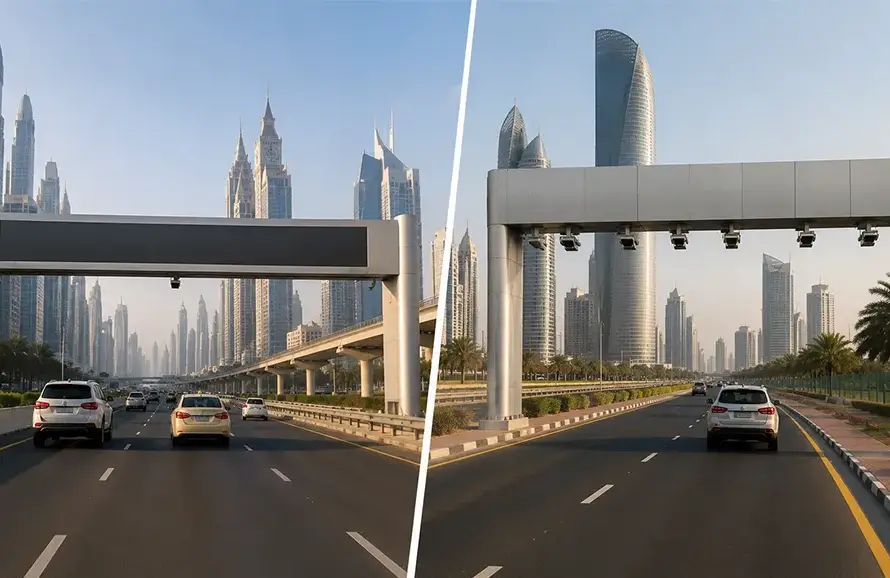


A red light in Dubai costs AED 1,000 and takes the car off you for a month. Most tourists find that out after the trip, when the rental company charges their card. This guide puts the Dubai driving rules that matter to visitors in one place, with the fine attached to each one.
Last updated: October 2026. We review the fines and toll prices every year and after any official change.
Quick Answer
The key Dubai driving rules for tourists: drive on the right, keep to posted limits (usually 60 to 120 km/h), never hold a phone (AED 800), belt up every passenger (AED 400), stop fully at red lights (AED 1,000 and a 30-day impound) and never drink at all before driving.
Visitors from more than 30 recognised countries can drive on their home licence. Everyone else needs an International Driving Permit.
Table of Contents
The 2026 Rules at a Glance
| Topic | What you need to know |
| Who can drive | Visit visa holders with a licence from a recognised country, or an IDP plus the original licence |
| Driving side | Right side of the road, overtake on the left |
| Speed limits | 100 to 120 km/h on highways, 60 to 80 km/h on main city roads, 25 to 40 km/h in residential streets |
| Speed cameras | Dubai radars usually flash around 20 km/h over the limit. Abu Dhabi has no buffer |
| Phone | AED 800 and 4 black points for holding it |
| Red light | AED 1,000, 12 black points, 30-day impound |
| Alcohol | Zero tolerance. Penalty set by a court, within the AED 20,000 to 100,000 range in the 2025 law, possibly with jail |
| Salik toll | AED 6.30 peak, AED 4.20 off-peak, free 01:00 to 06:00 |
| Paid parking | 08:00 to 22:00, Monday to Saturday. Sundays are free |
| Emergency | 999 police, 998 ambulance, 901 police non-emergency |
Can Tourists Drive in Dubai?
Yes. On a visit or tourist visa you can drive with a valid licence from a recognised country. The list covers the GCC states, the UK, the US, Canada, Australia, Japan, South Korea and most of Europe. If your country is not on it, carry an International Driving Permit (IDP) together with your original licence.
Indian, Pakistani and Filipino licences are the common examples that need an IDP. Our guide to the international driving license in Dubai has the full country list and how to get the permit before you fly.
Three things catch people out:
- The IDP must be issued at home. You cannot apply for one after landing in the UAE.
- Many rental companies check that the licence matches your passport country. A UK licence on an Indian passport is usually fine with an IDP, but ask before you book.
- A UAE residence visa ends the tourist route. Once you are a resident, you need a UAE licence.
Driving on a licence that is not valid in the UAE is no longer a small fine. The old fines list sets AED 400, but the federal traffic law in force since March 2025 allows courts to fine a first offence AED 2,000 to AED 10,000. Your rental insurance will not cover you either.
Before You Drive: The Paperwork
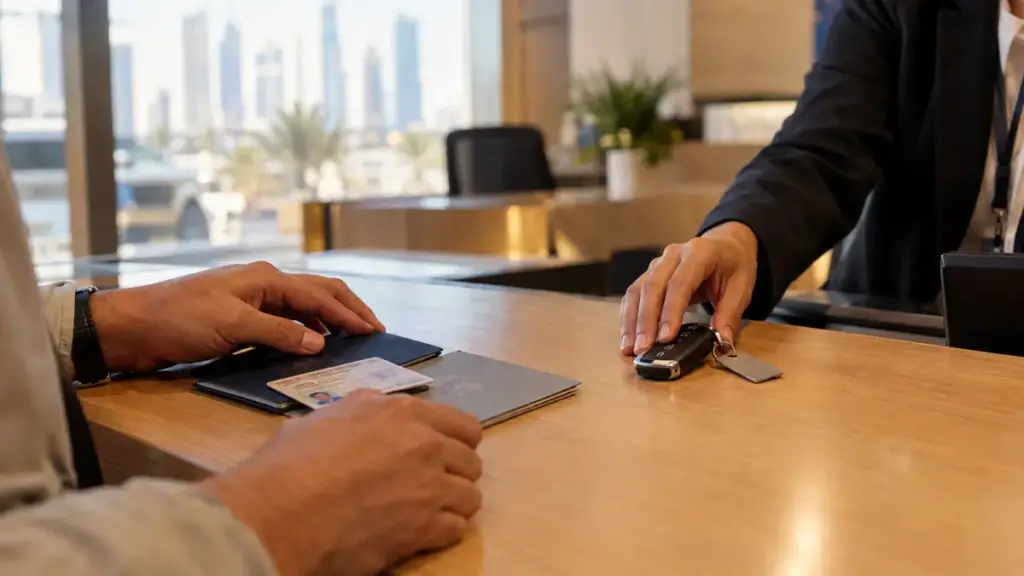
Keep these in the car on every trip:
- Your passport (or a clear copy, with the original in the hotel safe)
- Your home licence, plus your IDP if you need one
- The rental agreement and the car’s registration card (usually in the glovebox)
Most companies set the minimum age at 21, and 25 for luxury and sports cars. They also block a security deposit on a credit card in the driver’s name.
Only drivers named on the contract are insured. If a friend drives and has an accident, the insurance can refuse the claim, so add every driver at pickup. If you are unsure what your cover includes, read what CDW covers before signing.
The 25 Essential Dubai Driving Rules
We grouped the rules into six areas: speed, phone and seatbelts, lanes, junctions, zero tolerance and cameras. The fine for each is current for 2026.
Speed Limits and Cameras
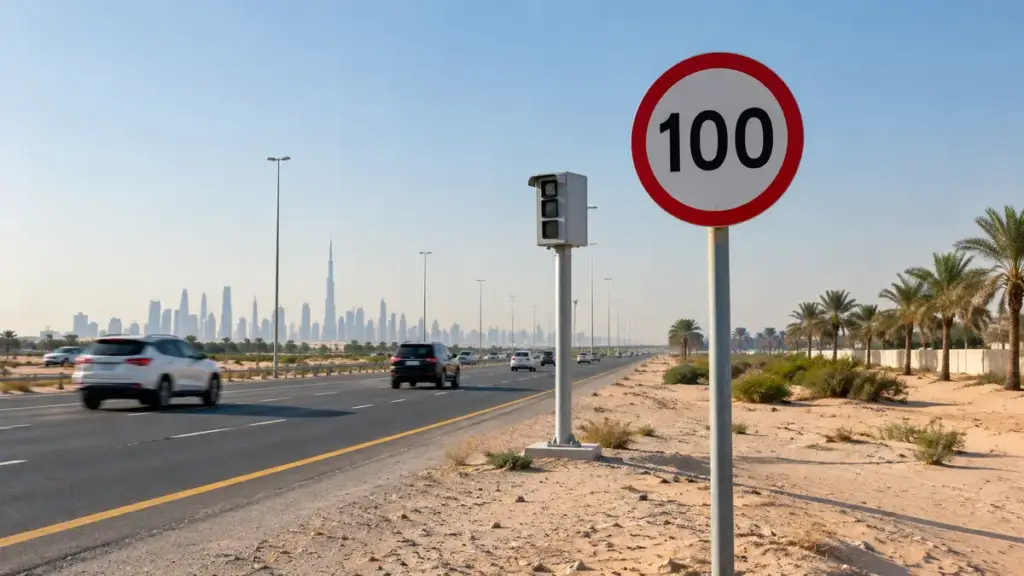
1. Follow the posted limit, not the road type
Signs always win. The table below shows the usual bands, but RTA changes limits on individual roads, and some stretches of the same highway switch between 100 and 120 km/h.
| Road type | Typical limit |
| Highways (E11, E311, E611) | 100 to 120 km/h |
| Main city roads | 60 to 80 km/h |
| Smaller city streets | 40 to 60 km/h |
| Residential areas | 25 to 40 km/h |
| School zones | 30 to 40 km/h |
| Car parks | 20 km/h or less |
2. Know how speeding fines step up
Speeding fines rise in bands. Going a little over is cheap. Going a lot over costs the car.
| Over the limit by | Fine | Black points | Impound |
| Up to 20 km/h | AED 300 | None | None |
| 21 to 30 km/h | AED 600 | None | None |
| 31 to 40 km/h | AED 700 | None | None |
| 41 to 50 km/h | AED 1,000 | None | None |
| 51 to 60 km/h | AED 1,500 | 6 | 15 days |
| 61 to 80 km/h | AED 2,000 | 12 | 30 days |
| More than 80 km/h | AED 3,000 | 23 | 60 days |
3. Do not count on the 20 km/h buffer
Fixed cameras in Dubai usually trigger around 20 km/h above the limit. This is an enforcement practice, not a law, and police patrols can fine you below it. Mobile radars in school zones and roadworks are often set tighter.
4. Drive the exact limit in Abu Dhabi
Many visitors take a day trip to the capital. Abu Dhabi cameras have no buffer, so 1 km/h over is enough for a fine. On Sheikh Mohammed bin Rashid Road (E11) there is also a minimum speed of 120 km/h in the two left lanes, and driving slower there costs AED 400.
Phone, Seatbelts and Children
5. Keep the phone in a mount
Holding a phone while driving costs AED 800 and 4 black points. Dubai has cameras that detect a phone in your hand, so the fine can arrive without any police car in sight. Set the route before you move.
6. Every passenger wears a seatbelt
Front and back seats, every trip. The fine is AED 400 and 4 black points, and the driver pays for each passenger not buckled up. Cameras catch this one too.
7. Children under 4 need a child seat
Kids under four must ride in a proper child seat. Ask for seats when you book, as they are not always available on the day. If you travel as a family, family SUVs and 7-seater rentals give you room for two or three seats.
8. Under 10s stay out of the front seat
Children under 10, or shorter than 145 cm, cannot sit in the front. The fine is AED 400.
Lanes, Distance and Overtaking
9. Drive on the right and overtake on the left
Traffic keeps to the right. The far left lane is for overtaking and fast traffic, and drivers coming up behind you will flash their lights. Move right once you have passed. Overtaking on the right is a fine of AED 600.
10. Leave a proper gap
Tailgating costs AED 400 and 4 black points, and in Dubai the car can also be impounded for 30 days. Police and cameras both enforce it. Keep at least two to three seconds behind the car in front, more in rain or fog.
11. Never drive on the hard shoulder
The shoulder is for emergencies and police only. Overtaking on it costs AED 1,000 and 6 black points. It is tempting in a jam. Do not.
12. Signal every lane change
Changing lanes without indicating is AED 400. A sudden swerve across lanes is far worse at AED 1,000 and 4 black points. Dubai roads have many lanes and exits come quickly, so pick your lane early.
13. Do not cut across lanes at the last second for an exit
Missing an exit is normal on your first day. Cutting across three lanes at the last moment to make it is dangerous and can be fined as sudden swerving. Take the next exit and turn back. Google Maps and Waze both reroute within a minute.
Junctions, Roundabouts and Priority
14. Stop on red, every time
Crossing a red light means AED 1,000, 12 black points and a 30-day impound. In Dubai, the release fee for a red light impound is AED 50,000 under Decree No. 30 of 2023. Every major junction has cameras, and amber is not an invitation to speed up.
15. Give way at roundabouts
Cars already on the roundabout have priority. Choose your lane before entering: right lane for the first exit, left lanes for exits further round. Not giving way is a fine plus black points, and roundabouts are a common spot for minor crashes.
16. Stop for pedestrians at crossings
Not giving way to a pedestrian at a marked crossing costs AED 500 and 6 black points. Many crossings in Dubai are in the middle of a block, not at junctions, so watch for the signs and road markings.
17. Move over for emergency vehicles
Blocking an ambulance, fire truck or police car is one of the costliest everyday mistakes: AED 3,000, 6 black points and a 30-day impound. Indicate and move to the side as soon as you hear the siren.
18. Stop for school bus signs
When a school bus opens its STOP arm, traffic in both directions must stop. Ignoring it costs AED 1,000 and 10 black points.
19. U-turn only where signs allow it
U-turns are legal at most signal-controlled junctions unless a sign says otherwise. They are not allowed on highways or across solid lines. Use the dedicated U-turn lanes on wide roads.
Zero Tolerance Rules
20. Do not drink and drive. At all
There is no legal alcohol limit in the UAE. Any amount is an offence. The case goes to court. Under the federal traffic law in force since 2025, the court can fine AED 20,000 to AED 100,000 and/or jail, and suspend the licence for at least 3 months. Your rental insurance will also not cover anything that happens. If you plan to drink, take a taxi.
21. Keep road rage off the road
Rude hand gestures, shouting or insulting another driver can be reported to police, and offensive gestures can lead to criminal charges and a fine. Flashing lights and honking are as far as it should go.
22. Do not film or photograph accident victims
Taking or sharing photos of people injured in a crash is a criminal offence in the UAE. Photographing the cars and damage for your own claim is fine.
Cameras, Fines and Leaving the Country
23. Assume a camera sees everything
Dubai cameras now detect speeding, red lights, phone use, missing seatbelts, tailgating and lane violations. Many fines are issued by camera rather than at a police stop, so you may not know about one until you check the plate.
24. Know that fines follow the car, not you
Every fine is tied to the number plate. With a rental, the fine goes to the rental company first. Most companies pay it and charge your card, often with an admin fee, so ask about their policy at pickup. You can check traffic fines for a rental car yourself on the Dubai Police app using the plate number.
25. Check for fines before you fly home
Check the plate on the Dubai Police app or website 24 to 48 hours before you return the car. If a fine looks wrong, dispute it while you are still in the country. Dubai also runs traffic fine discounts for early payment on some violations, which can lower the bill.
Dubai Traffic Fines List 2026
These are the violations tourists actually get. Amounts follow the federal fines list, with Dubai’s own impound rules added.
| Violation | Fine (AED) | Black points | Other penalty |
| Speeding up to 20 km/h over | 300 | None | None |
| Speeding 21 to 50 km/h over | 600 to 1,000 | None | None |
| Speeding 51 to 60 km/h over | 1,500 | 6 | 15-day impound |
| Speeding 61 to 80 km/h over | 2,000 | 12 | 30-day impound |
| Speeding more than 80 km/h over | 3,000 | 23 | 60-day impound |
| Running a red light | 1,000 | 12 | 30-day impound |
| Holding a phone while driving | 800 | 4 | None |
| No seatbelt (driver or passenger) | 400 | 4 | None |
| Child under 4 without a child seat | 400 | None | None |
| Tailgating | 400 | 4 | 30-day impound in Dubai |
| Overtaking on the hard shoulder | 1,000 | 6 | None |
| Sudden swerving | 1,000 | 4 | None |
| Not indicating | 400 | None | None |
| Not giving way to pedestrians | 500 | 6 | None |
| Blocking an emergency vehicle | 3,000 | 6 | 30-day impound |
| Ignoring a school bus STOP sign | 1,000 | 10 | None |
| Littering from the car | 1,000 | 6 | None |
| Licence not valid in the UAE | 400 (fines list), up to 10,000 if referred to court | None | Insurance invalid |
| Driving under the influence of alcohol | 20,000 to 100,000 | None | Court, possible jail, licence suspension |
| Not paying for parking | 150 | None | None |
Black points: 24 points within 12 months suspends your licence. Points stay on record for one year.
Impound release: Dubai charges a separate release fee for impounded cars under Decree No. 30 of 2023, from AED 10,000 up to AED 100,000 depending on the offence. With a rental car, check your contract to see how the company handles this.
The Five Mistakes That Cost Tourists the Most
We ranked these by what they usually cost a visitor in total, including impound and rental company charges.
| Mistake | Typical total cost | Why it happens |
| Drinking before driving | Court penalty up to AED 100,000 and possible jail | Visitors assume a small amount is fine, as at home |
| Running a red light | AED 1,000 fine plus impound costs passed on by the rental company | Speeding up on amber at wide junctions |
| Blocking an emergency vehicle | AED 3,000 plus impound | Not hearing the siren with the AC and music on |
| Driving on a licence not valid in the UAE | AED 400 up to 10,000, and no insurance cover | Not checking the IDP rule before the trip |
| Many small Salik and parking charges | AED 100 to 300 over a week, plus admin fees | Not knowing the rental company charges a fee per item |
The last one is not a fine, but it is the one almost every tourist pays. Ask at pickup how much the company adds per Salik crossing and per fine.
What to Do If Police Stop You
Being stopped is rare for tourists, since most fines come from cameras. If it does happen:
- Turn on your hazard lights and pull over to the right as soon as it is safe.
- Stay in the car with your hands visible. Do not get out unless asked.
- Lower the window and turn off the engine.
- Hand over your licence, IDP, passport (or copy) and the rental agreement.
- Stay calm and polite. Most officers speak English. Arguing on the spot does not help, and you can dispute a fine later through the app.
Do not try to pay the officer in cash. Fines are recorded against the plate and paid later through official channels.
What to Do After an Accident
Minor accident, nobody hurt: move the cars to the side if they can be driven. Take photos of both cars, the plates and the location, then report it through the Dubai Police app. You need a police report for the rental company. Without it, the insurance claim will not go through.
Anyone injured: do not move the cars. Call 999, stay at the scene and wait for police. Leaving the scene of an accident with injuries can mean up to two years in jail and a fine of AED 50,000 to AED 100,000.
Call the rental company right after the police. Most have a 24-hour number on the key tag or contract.
Salik Tolls and Parking: The Short Version
Both are charged automatically to the rental company and then to you. Here are the current numbers. For full details, see our guides on what Salik is and how it works and Dubai parking timings and zones.
Salik toll gates (10 gates, prices include 5% VAT from 1 June 2026):
| Time | Monday to Saturday | Sunday |
| 06:00 to 10:00 and 16:00 to 20:00 | AED 6.30 (peak) | AED 4.20 |
| 10:00 to 16:00 and 20:00 to 01:00 | AED 4.20 | AED 4.20 |
| 01:00 to 06:00 | Free | Free |
During Ramadan the bands change: free from 02:00 to 07:00 and peak from 09:00 to 17:00.
Parking: paid from 08:00 to 22:00, Monday to Saturday. Nights, Sundays and public holidays are free in public street parking, but malls and multi-storey car parks set their own rules. Standard zones cost AED 4.20 per hour at peak times (08:00 to 10:00 and 16:00 to 20:00). Pay by the RTA or Parkin app, SMS or machine. An unpaid ticket is AED 150.
Fuel is the other running cost. Check current petrol prices in the UAE before a long drive.
FAQ: Dubai Driving Rules for Tourists
Drive on the right, keep to posted speed limits, never hold your phone, make every passenger wear a seatbelt and stop fully at red lights. Alcohol is zero tolerance. Tourists need a licence from a recognised country, or an IDP with their original licence.
Usually 100 to 120 km/h on highways, 60 to 80 km/h on main city roads and 25 to 40 km/h in residential areas. Posted signs always override these general bands, and limits can change along the same road.
AED 800 and 4 black points. Cameras catch many of these offences, so you may not see a police car. Using a phone mount with navigation set before you drive is allowed.
Yes, if the licence is from one of the recognised countries (more than 30), such as the UK, US, Canada, Australia or most of Europe. Other visitors, including those with Indian licences, need an International Driving Permit together with the original licence.
The fine is linked to the car’s plate. With a rental, most companies pay it and charge your card, often with an admin fee. Unpaid fines can be charged after you leave, and serious unpaid fines may cause problems on a future visit.
Fixed cameras in Dubai usually flash at about 20 km/h over the limit, but this is not a legal right. Police can fine you for any speed above the limit. Abu Dhabi has no buffer at all.
Yes. Children under 4 must use a child seat, and children under 10 or shorter than 145 cm cannot sit in the front. Each breach is AED 400. Request seats from the rental company when booking.
No. Sunday crossings cost a flat AED 4.20 all day. The only free time is 01:00 to 06:00, every day.
Public street parking is free from 22:00 to 08:00, all day Sunday and on public holidays. Multi-storey car parks and private car parks such as malls set their own charges.
Sources
Fines and penalties in this guide were checked in October 2026 against the UAE federal traffic fines list (Ministry of Interior), Federal Decree-Law No. 14 of 2024 on traffic, Dubai Decree No. 30 of 2023 on vehicle impounding, and published rates from Salik, Parkin and the RTA. The list of countries whose licences are accepted is kept by the RTA. Laws and amounts change, so check these sources if you read this after 2026