


Which Is Better for You in 2026?
Most travelers in Dubai lose the first hour of their holiday at the rental counter, second-guessing between an SUV and a sedan. Pick wrong and the consequences surface within 48 hours: luggage wedged between knees, a cabin that refuses to cool, or a final bill 40 percent heavier than expected.
Maps make the city look like a tidy grid. Reality lands at Terminal 3, 45-degree heat, parking bays sized for hatchbacks, a friend texting about a sunset desert trip. The SUV-versus-sedan call suddenly matters. This 2026 guide lays out the numbers we see daily at the desk: real rates, fuel burn, parking friction, and six scenarios pulled from actual customer trips.
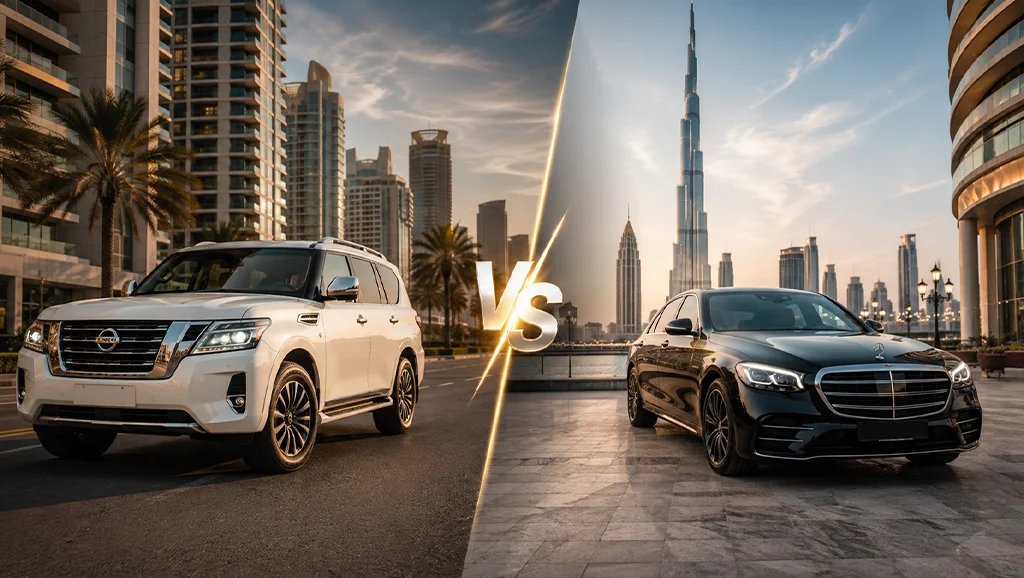
Table of Contents
The Quick Answer: SUV vs Sedan in Dubai
Short version for readers who scrolled straight here. Rent an SUV for three or more people, a planned desert safari, a June-to-September arrival, or strollers and oversized luggage in tow. Rent a sedan for solo travel, a couple, city-only stays, and a tight dirham count.
SUVs run 30 to 50 percent more per day, but they absorb Dubai’s heat, sand, and family chaos better than any sedan manages. Use the table below as a starting filter, then read on for the nuance.
| Situation | Better Pick |
|---|---|
| 4+ passengers or kids with gear | SUV |
| Solo or couple, city-only trip | Sedan |
| Desert safari on the itinerary | SUV (4×4 mandatory) |
| June–September visit | SUV |
| Budget under AED 150/day | Sedan |
| Daily Sharjah–Dubai commute | Sedan |
Choose SUV If You Plan To…
- Travel with a family of 4+, especially with young children and car seats.
- Drive into the desert — even a sunset safari needs proper 4×4 clearance.
- Visit June–September, when cabin heat saturation is a daily reality.
- Move luggage for 3+ people, strollers, or golf bags.
- Drive to Hatta, Ras Al Khaimah, or Fujairah on a regular basis.
Choose Sedan If You Plan To…
- Travel solo, as a couple, or with one child in a standard seat.
- Stay mainly inside Dubai — Downtown, Marina, JBR, Business Bay, airports.
- Run a tight daily budget under AED 200, including fuel.
- Park frequently in Deira, Bur Dubai, or Al Quoz, where bays are tight.
- Prefer a quieter highway ride and lower wind noise at 120 km/h.
SUV vs Sedan Dubai: Side-by-Side Comparison
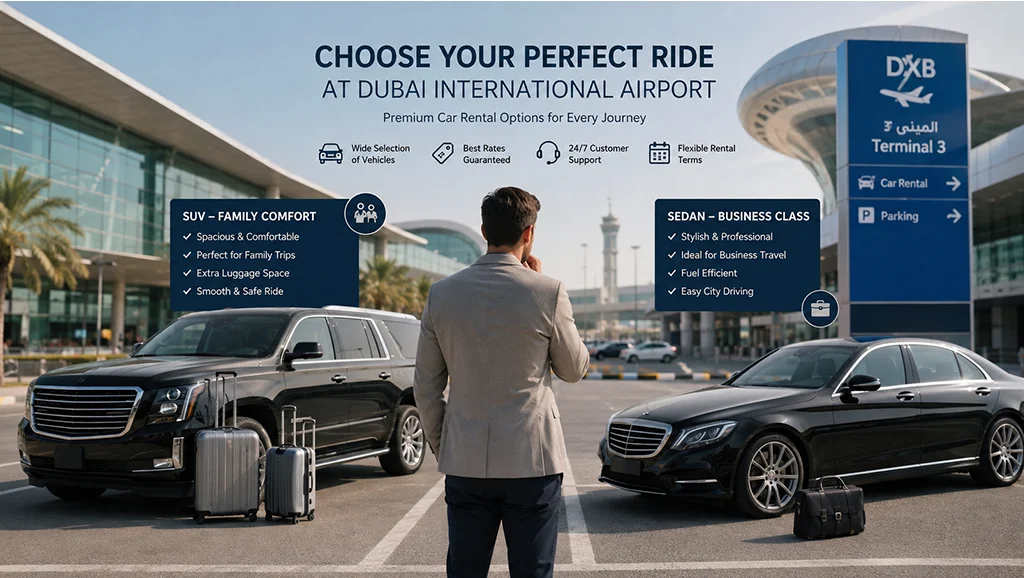
| Factor | SUV | Sedan | Verdict |
| Daily rate (AED) | 200–3,000 | 80–500 | SUV 2–6× pricier |
| Fuel (L/100km) | 8–15 | 5–9 | Sedan 30–50% cheaper |
| Boot space (L) | 500–2,500 | 350–500 | SUV far ahead |
| Seats | 5–8 | 4–5 | SUV for groups |
| Ground clearance (mm) | 180–280 | 120–160 | SUV for sand/floods |
| Mall parking | Tight | Easy | Sedan wins |
| Desert capability | 4×4 available | Not recommended | SUV essential |
1. Price Comparison: SUV vs Sedan Rental Costs
Economy sedans like the Mitsubishi Attrage and Nissan Sunny start around AED 70 to 120 per day, with weekly deals pulling the effective rate lower still. Compact SUVs such as the Hyundai Tucson or Mitsubishi Outlander open closer to AED 200 to 250. Full-size names — Toyota Land Cruiser, Nissan Patrol, Range Rover — climb to AED 350 to 800 and well beyond.
The headline gap looks dramatic. Most of it sits at the luxury end. A sensible mid-size SUV runs only 60 to 80 percent above an equivalent sedan, not the sixfold figure that luxury listings suggest. Compare like with like and the SUV premium shrinks considerably.
2. Fuel Consumption: SUV vs Sedan in Dubai
A sedan like the Attrage or Corolla burns roughly 5 to 7 liters per 100 kilometers. A mid-size SUV sits at 9 to 11, and a Patrol or Land Cruiser drinks 13 to 15 on city cycles. With Special 95 around AED 2.58 per liter in late 2025 and trending upward, the weekly fuel math is straightforward.
A 350-kilometer week adds about AED 130 in a sedan and AED 250 to 320 in a typical SUV. Real, but rarely decisive. Smaller than most travelers assume before running the numbers, and easy to absorb inside a normal holiday budget.
3. Space and Comfort: SUV vs Sedan Interior
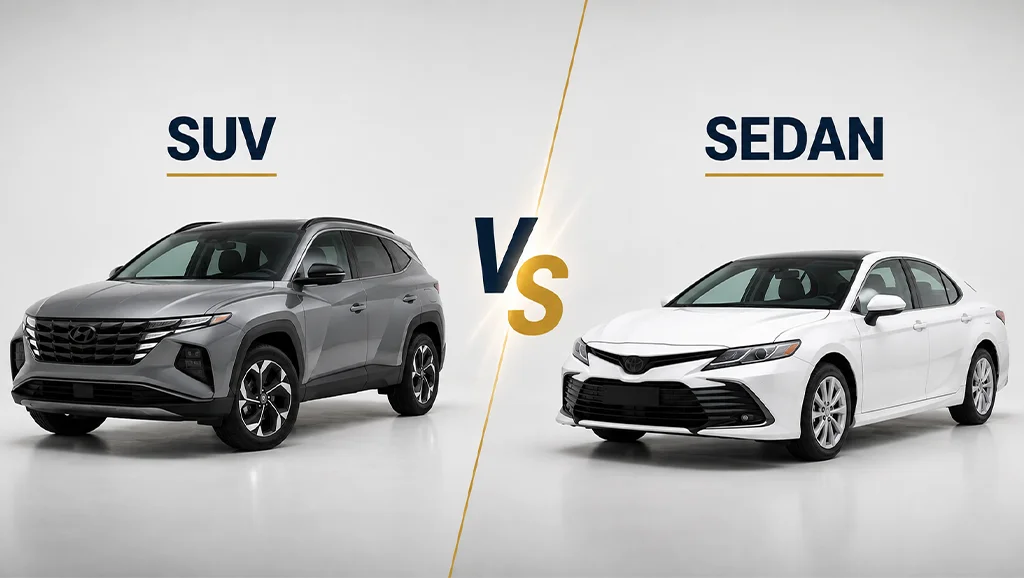
Sedans cap out around 400 to 500 liters of trunk volume. That fits two large suitcases and a couple of backpacks. Enough for a couple, tight for a family. Mid-size SUVs deliver 500 to 1,000 liters with seats up and double that when folded.
The higher roofline and upright seating make loading car seats, strollers, and grocery runs dramatically easier. Anyone traveling with toddlers will appreciate the difference within the first hour of the trip. It is a daily quality-of-life upgrade, not a luxury.
4. Safety: SUV vs Sedan on Dubai Roads
Dubai’s highways are among the safest in the region, and both body styles perform well in standard crash tests. SUVs trade better visibility and mass for a slightly higher rollover risk during sharp maneuvers.
Where the SUV pulls ahead decisively is low-traction situations: wet roads during the rare winter rains, sand drifts near outer suburbs, and any desert activity. For pure city driving, the safety gap is narrow enough to ignore.
5. Parking and Maneuverability in Dubai
Mall of the Emirates, Dubai Mall, and Ibn Battuta all run tight multi-level parking that punishes long-wheelbase SUVs. A sedan slips into a standard spot in seconds. A Patrol or Land Cruiser often needs two attempts or a corner slot.
Street parking in older districts like Deira and Bur Dubai is tighter still. If most of the trip is mall-hopping in central Dubai, the sedan’s smaller footprint saves time every single day.
6. Desert Capability: The Deciding Factor
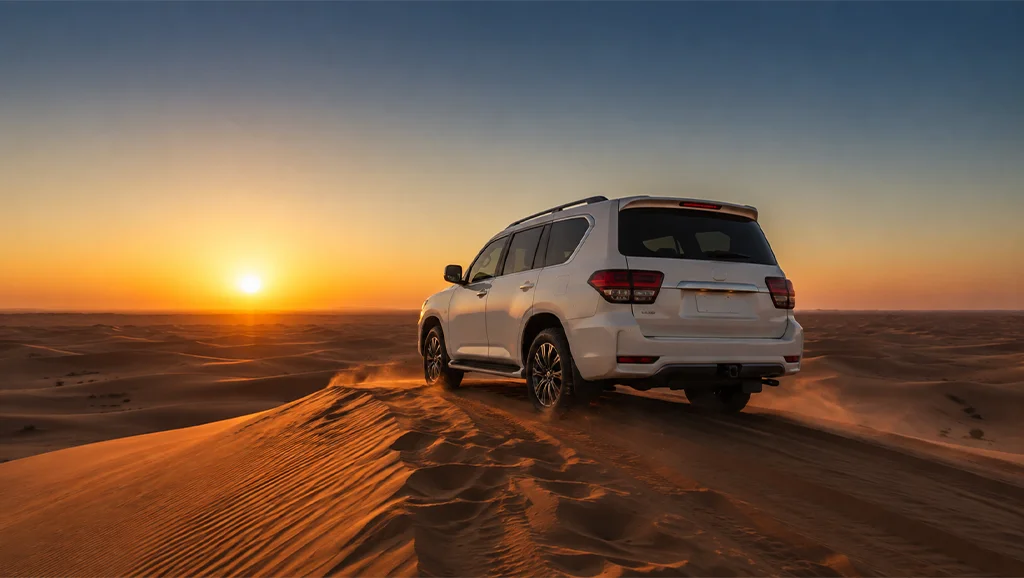
This is the one area with no real debate. Sedans cannot safely drive on sand because they lack ground clearance, low-range gearing, and appropriate tires. Even AWD crossovers like a Honda CR-V get beached in soft dunes within minutes.
A proper 4×4 SUV like the Patrol, Land Cruiser, Defender, or Wrangler is essential for any self-driven desert trip. The alternative is booking an organized safari with transport included, which often makes more sense for short visits.
Real Dubai Scenarios: SUV vs Sedan Winner
Scenario 1: Family Vacation with Kids
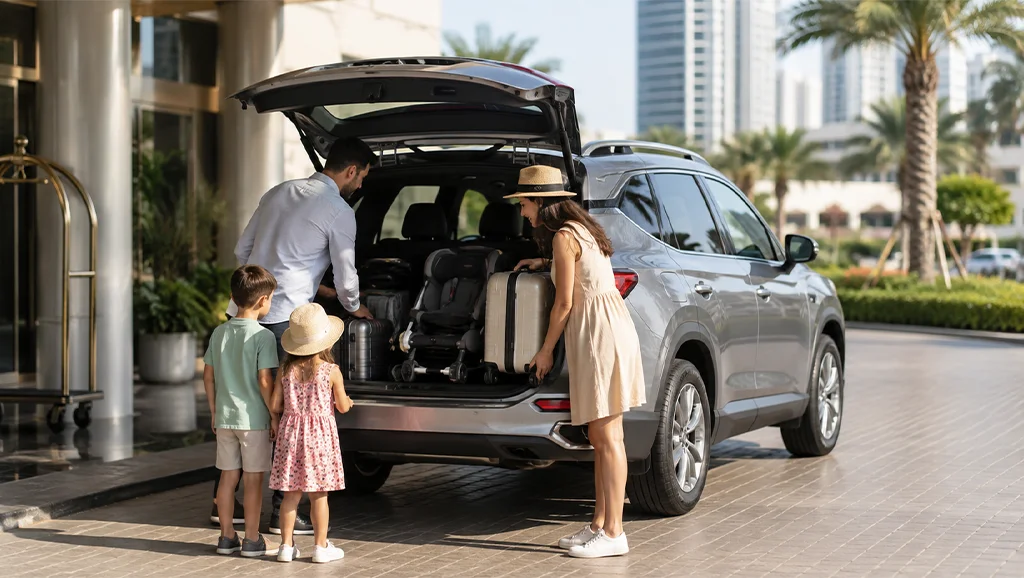
Two adults, two children, a double stroller, and three suitcases. The sedan loses this race immediately. A Toyota Camry’s 480-liter trunk swallows two suitcases and nothing else. A Mitsubishi Outlander’s 1,020 liters takes all of it with room to spare, and the higher roof makes strapping in car seats far less back-breaking.
The AED 100 to 150 daily premium disappears behind the comfort and sanity saved.
Scenario 2: Desert Safari Adventure
Anyone planning a Hatta or Lahbab dune trip needs a 4×4 SUV, full stop. The smarter move is often to rent a sedan for city days and book a guided safari separately. The cost works out similar, and you avoid putting off-road wear on a vehicle you are responsible for.
If self-driving the desert is non-negotiable, our SUV rental in Dubai fleet includes Patrol and Land Cruiser models with proper off-road tires and recovery kits.
Scenario 3: Business Trip in Dubai
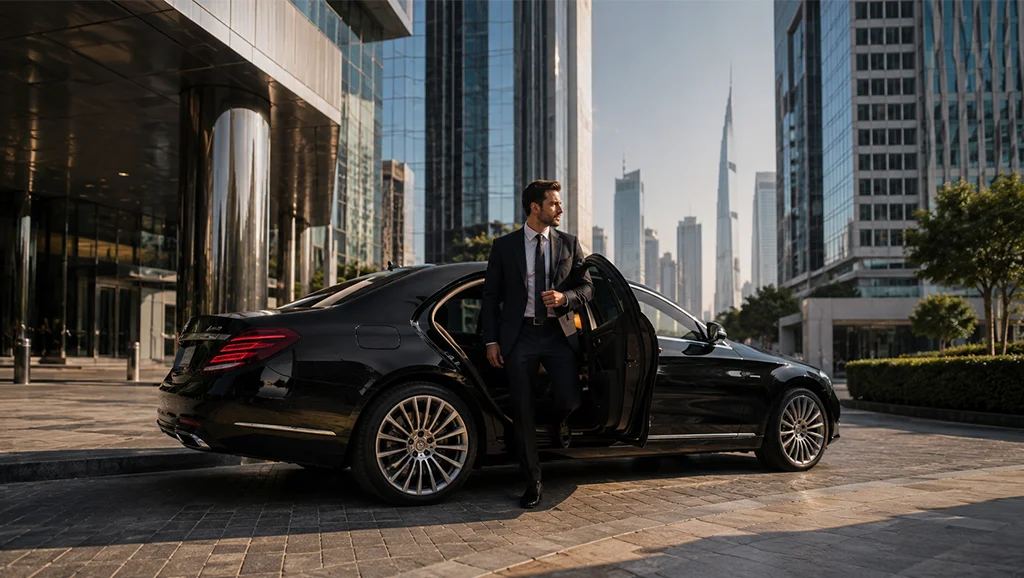
A visiting executive moving between DIFC, Downtown, and airport hotels needs three things: easy parking, a quiet cabin, and a low profile. A BMW 5 Series or Mercedes E-Class delivers all three and projects the right image for client meetings.
A large SUV is harder to park, more conspicuous, and adds nothing here. Sedan wins, unless the itinerary includes a desert dinner with clients. For city-only business trips, our sedan rental in Dubai options cover everything from Camry to E-Class.
Scenario 4: Solo Tourist for a Week
One person, one suitcase, mostly metro-adjacent hotels. A Nissan Sunny or Mitsubishi Attrage at AED 70 to 100 per day is the rational pick. Easy to park, cheap to fuel, and adequate for the 30 to 50 kilometers most solo tourists actually drive daily.
An SUV here is overkill. You pay for space you never use and fight parking spots you do not need.
Scenario 5: Sharjah–Dubai Daily Commute
Living in Sharjah and working in Dubai means 60 to 80 kilometers each way, mostly on Sheikh Mohammed bin Zayed Road. Fuel costs and seat comfort matter more than boot space. A fuel-sipping sedan wins on running costs, but a mid-size SUV wins on driver comfort over a 90-minute commute.
The honest call is a comfortable sedan like the Camry, Accord, or Sonata, which splits the difference nicely.
Scenario 6: Group of 5+ Friends
Five adults in a sedan means arguments, cramped legs, and luggage in laps. A 7-seater SUV like the Toyota Fortuner, Nissan Patrol, or Chevrolet Tahoe turns the same trip into a shared road-trip memory. Split five ways, the daily rate per person is often lower than a sedan split two ways. SUV wins, comfortably.
Cost Analysis: Total Cost of SUV vs Sedan in Dubai
Assumptions: seven-day rental, 50 km daily driving (350 km total), four Salik crossings per day, and five paid mall parking visits. CDW insurance is included by most Dubai rental companies at the quoted daily rate.
| Cost Item (7 days) | SUV (AED) | Sedan (AED) |
| Daily rate × 7 | 1,400–5,600 | 560–1,050 |
| Fuel (350 km) | 250–470 | 130–235 |
| Salik (4 gates × 7) | 112 | 112 |
| Mall parking (5 visits) | 100 | 100 |
| Insurance (CDW) | Included | Included |
| Total 7-day cost | 1,862–6,282 | 902–1,497 |
Daily Rental Cost Difference
A reasonable mid-size SUV runs AED 200 to 350 per day, against AED 80 to 150 for an economy sedan. That is a daily gap of AED 100 to 200, which compounds to AED 700 to 1,400 over a week. Luxury SUVs blow this range open. A Range Rover can hit AED 1,500 per day, but those belong in a different decision entirely and should not cloud the mid-market comparison.
Salik and Parking Fees
Salik tolls apply equally to every vehicle: AED 6 per gate during peak hours (9 AM to 5 PM) and AED 4 off-peak, with Sundays free. Four crossings daily means AED 16 to 24 in tolls, identical for SUV and sedan. Mall parking is also vehicle-agnostic.
The hidden cost is time. An SUV hunting for a wide-enough spot in Dubai Mall wastes minutes a sedan never loses.
Dubai-Specific Factors Most Guides Ignore
Summer Heat: SUV AC vs Sedan AC
When ambient temperature hits 48°C in July, cabin cooldown time matters. SUVs carry larger AC compressors and more cabin volume to chill, which means they take longer to cool but hold temperature better once there. Sedans cool faster but heat up faster too when parked.
Either works, but an SUV with rear AC vents is meaningfully more comfortable for back-seat passengers during peak summer weeks. Traveling with kids in July or August, this single factor can outweigh the daily rate difference.
Flood Risk: SUV Ground Clearance Advantage
Dubai’s 2024 floods were a reminder that rare rain events do happen here. A sedan with 130 mm of ground clearance can stall in 20 cm of standing water. An SUV with 200 mm or more clears the same depth comfortably.
The risk window is small, a handful of days per year, but if you are visiting in February or March, it is worth knowing before you commit. Rental insurance typically excludes water damage, so the bill for a flooded sedan engine falls on the renter.
School Run and Car Seats
Dubai taxis and ride-hailing cars rarely carry child seats, which is why many visiting families rent. SUVs make installing ISOFIX car seats far easier thanks to higher door sills and more headroom.
The same installation in a low-slung sedan means crouching in a parking garage for ten minutes per seat. A small but real friction point when you are doing it twice a day across a week-long family trip.
Popular SUV vs Sedan Models in Dubai
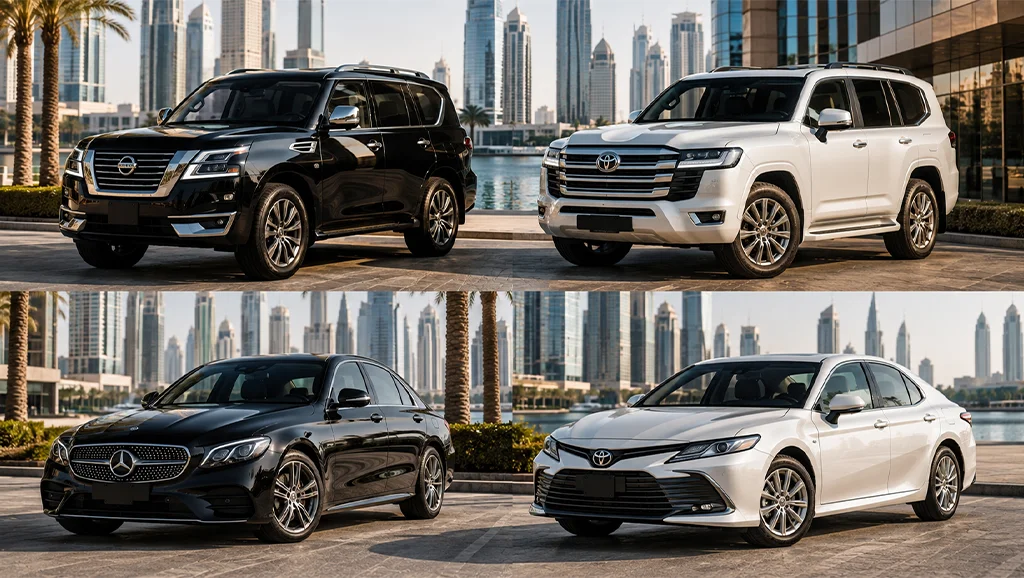
Nissan Patrol vs Toyota Camry
The classic Dubai matchup. The Patrol (AED 500 to 750 per day) is the desert-going family hauler of choice: eight seats, V8 torque, and respect on every road. The Camry (AED 150 to 200 per day) is the city and airport-run benchmark, comfortable, reliable, anonymous. They serve different trips entirely, and most travelers do not need both.
Range Rover vs BMW 5 Series
At AED 1,200 to 1,800 per day for a Range Rover and AED 600 to 900 for a BMW 5 Series, both sit in the premium tier. The Range Rover makes a statement and handles desert comfortably. The BMW is quieter on the highway, easier to park, and arguably more refined for executive travel.
Hyundai Tucson vs Toyota Corolla
The sensible-shoes comparison. Tucson (AED 200 to 250 per day) gives you 600 liters of boot, higher seating, and light SUV capability. Corolla (AED 120 to 150 per day) is cheaper, more efficient, and arguably better-built.
For a couple on a mid-budget trip, this is the decision that actually matters, and the Tucson usually wins by a small margin.
Common Myths About SUV vs Sedan in Dubai
Myth 1: SUVs Are Always More Expensive
Headline rates suggest a sixfold gap, but real-world mid-size SUVs sit closer to 60 to 80 percent above economy sedans. Per-person cost for a group of five often flips the equation entirely. The “SUVs are unaffordable” claim falls apart the moment you split the bill across the people actually sitting in the vehicle.
Myth 2: Sedans Are Safer in Dubai
On dry city roads, the safety gap is negligible. In rare rain, in sand drifts near Mirdif and Al Warqa, and on any desert track, the SUV is dramatically safer. The blanket “sedans are safer” line ignores context and oversells a narrow advantage that evaporates the moment road conditions stop being perfect.
Myth 3: SUVs Consume Too Much Fuel
They do consume more, roughly 30 to 50 percent more, but UAE fuel prices remain among the lowest in the world. Over a typical tourist week of 350 kilometers, the difference lands at AED 100 to 200, rarely the deciding factor. Rent the vehicle that fits your trip, not the one that soothes a fuel anxiety the local pump prices barely justify.
Insights From Dubai Rental Cars Experience
We have handed keys to thousands of renters at Dubai Rental Cars, and the SUV-versus-sedan hesitation shows up at the counter every day. The most common struggle is not price. It is overestimating how much car the trip actually needs.
Families of three routinely book a Patrol “just in case,” then spend a week fighting tight mall parking for a vehicle that never leaves tarmac. Solo travelers downgrade to a Sunny and regret it the moment a Friday jam on Sheikh Zayed Road leaves them with no legroom to stretch into.
From our experience, the mistakes that come up most are ignoring summer AC capacity, forgetting that Salik adds up across a week, and underestimating how tight older-district parking really is. Customers who choose well usually have one clear factor driving the decision: a desert trip, a child seat, a strict daily cap. Those who struggle try to optimize for every possible scenario at once.
Pick the vehicle that fits your actual trip, not the trip you might hypothetically have.
How to Decide: 5-Question Quiz
Answer each question honestly, then count SUV answers:
- Traveling with three or more people? — SUV / Sedan
- Any desert or off-road activity planned? — SUV / Sedan
- Visiting between June and September? — SUV / Sedan
- Daily budget above AED 250? — SUV / Sedan
- Need to carry bulky luggage, strollers, or sports gear? — SUV / Sedan
Three or more SUV answers, rent an SUV. Two or fewer, a sedan will serve you better. Tied at 2 to 3? Default to SUV if desert is on the list, otherwise sedan.
FAQ about Comparison of SUV and sedan cars
It depends on the trip. SUVs win for families, desert trips, summer visits, and heavy luggage. Sedans win for solo travelers, city-only itineraries, and tight budgets. For tourists staying five days or longer with a group, the SUV’s versatility usually justifies the premium, and per-person cost often narrows the gap considerably.
Choose an SUV for three or more passengers, desert activities, or a June to September visit. Choose a sedan for solo travel, Downtown-only stays, and budgets under AED 150 per day. First-time visitors with mixed plans usually benefit from the SUV’s flexibility.
Yes, by roughly 30 to 50 percent on a mid-size comparison. A Nissan Patrol at AED 500 per day versus a Toyota Camry at AED 150 per day is typical. Split across five passengers, the per-head SUV rate can actually fall below the sedan split two ways.
Both are safe on Dubai’s modern highways. SUVs offer better visibility and mass but a higher rollover risk in sharp maneuvers. Sedans handle sudden lane changes more confidently. For desert driving, the SUV is significantly safer.
No. Sedans lack the ground clearance, 4×4 drivetrain, and tires needed for sand. Even AWD crossovers struggle on soft dunes and frequently get stuck. Any desert trip requires a proper 4×4 SUV like the Patrol, Land Cruiser, Defender, or Wrangler, ideally with recovery gear.
Our Recommendation Based on Dubai Rental Cars Experience
Rent the SUV if your trip mixes family, summer heat, and even one desert afternoon. The premium pays for itself in comfort and capability. We have seen the relief on parents’ faces when the AC finally catches up at 4 PM in July, and that moment is worth more than the daily rate difference.
Rent the sedan if you are solo or a couple, staying central, and watching spend. A Camry or Attrage handles 90 percent of city itineraries without complaint, and saves AED 700 to 1,400 over a week better spent on dinner at Pier 7 or a desert tour.
The mistake we see most is choosing on price alone. A sedan that cannot fit your luggage, or an SUV that cannot fit Dubai Mall’s parking bays, both ruin a trip, just differently. Pick the vehicle that matches your actual itinerary. Reserve early for peak season (November to March and Eid weeks), and the right car will be waiting when you land.
Explore Available Rental Cars in Dubai
Browse our available vehicles and find the right option for your Dubai trip. From economy sedans to full-size 4×4 SUVs, every vehicle is recent-model, fully insured, and available for daily, weekly, or monthly hire with free delivery across Dubai.



1 Comment