

If you have ever driven through Dubai, you have probably noticed those orange-and-white overhead gantries on Sheikh Zayed Road and the creek bridges, and quietly wondered what they actually do. That is Salik, Dubai’s toll system, and it works whether you stop or not.
In this guide from Dubai Rental Cars, we break down exactly what Salik is, how it works, what it costs in 2026, where every toll gate is located, how to register a tag, what happens with rental cars, and how to keep your monthly toll bill as low as possible.
Quick Summary
Before we get into the details, here is a quick snapshot of everything you need to know about the Salik toll system at a glance:
| Quick Fact | What You Need to Know |
|---|---|
| What is Salik? | Dubai’s electronic, barrier-free toll collection system |
| Launched | 1 July 2007 by the RTA |
| Technology | RFID vehicle tag + ANPR (number plate) cameras |
| Number of Toll Gates | 10 across Dubai |
| Peak Hour Charge | AED 6 per crossing |
| Off-Peak Charge | AED 4 per crossing |
| Free Hours | 1:00 AM – 6:00 AM daily |
| Sunday Rate | Flat AED 4 all day (except 1–6 AM free window) |
| Tag Price (Online) | AED 120 (= AED 50 tag + AED 50 balance + AED 20 delivery) |
| Tag Price (In Person) | AED 100 (= AED 50 tag + AED 50 balance) |
| Customer Service | 800 SALIK (800 72545), available 24/7 |
| Daily or Monthly Cap | None — every crossing is charged individually |
Table of Contents
What Is Salik?
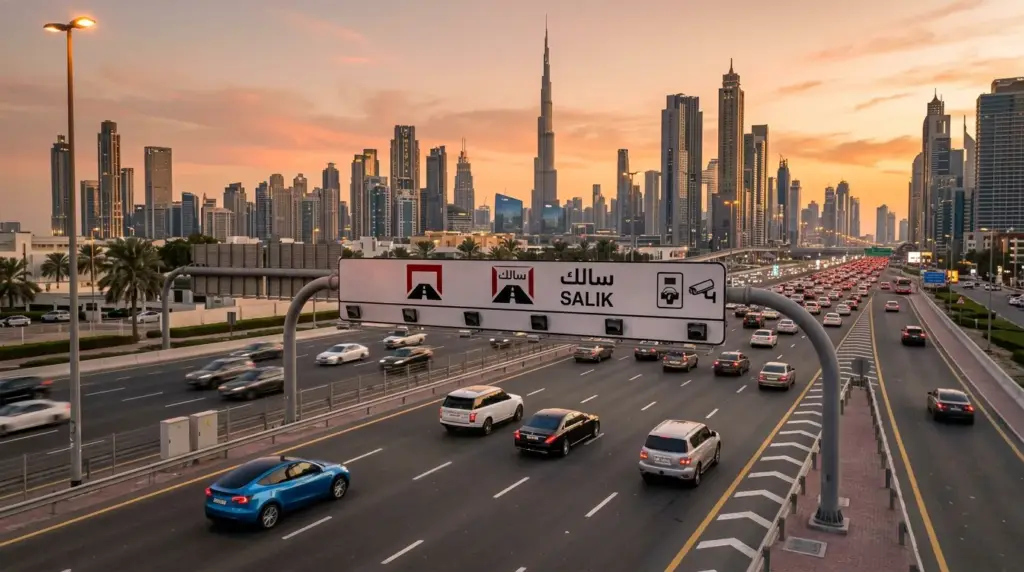
Salik is Dubai’s automatic toll collection system, and the name itself comes from the Arabic word for “clear” or “open.” The system was launched by the Roads and Transport Authority (RTA) on 1 July 2007 to keep traffic flowing on the city’s busiest corridors without forcing drivers to slow down, queue, or pay cash at a booth. There are no barriers, no toll operators, and no coins to throw into a basket — just overhead sensors that quietly read a small sticker on your windscreen and deduct the toll from your prepaid account as you drive underneath at full highway speed.
Today, Salik operates ten toll gates positioned across the city’s main arteries, including four on Sheikh Zayed Road alone. What is Salik in practical terms for an everyday driver? It is an invisible fee that shows up on your account statement every time you cross a gate, with the rate depending on what time of day you made the trip. The system became a public joint stock company (Salik Company PJSC) in July 2022, meaning it is now a publicly-traded entity on the Dubai Financial Market, but it still operates under the regulatory umbrella of the RTA.
Why Does Dubai Use the Salik Toll System?
Dubai in the mid-2000s was growing at a pace that few cities in the world had ever experienced. Car ownership was surging, the population was doubling every few years, and the main Dubai Roads — particularly Sheikh Zayed Road and the creek crossings between Deira and Bur Dubai — were choking with congestion during rush hour. Building more roads alone was not going to solve the problem; the city needed a way to actively manage demand and redistribute traffic.
Salik was the answer. By charging a small, predictable fee to use the busiest roads, the system nudged some drivers toward public transport, shifted others to off-peak travel times, and redirected the rest to alternative routes. The barrier-free RFID technology meant traffic kept moving at full speed — no queues, no idling engines, no extra emissions. And the revenue generated flowed directly back into Dubai’s transport budget, helping fund metro extensions, new bridges, and the road upgrades you see across the city today. In short, the Dubai toll system is not just about collecting money — it is a traffic management tool that has helped the city stay drivable as it has grown.
How Does the Salik Toll System Work?
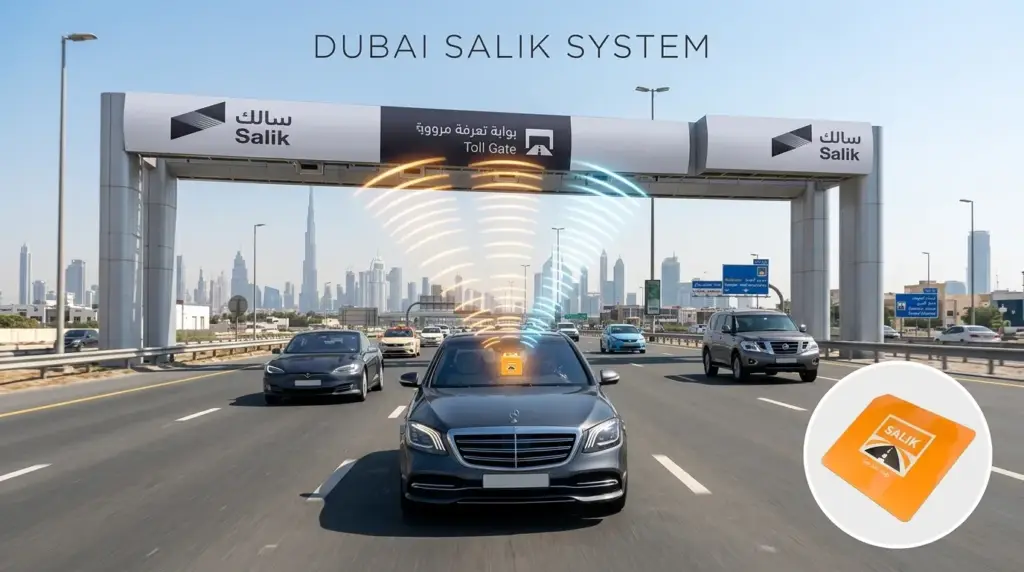
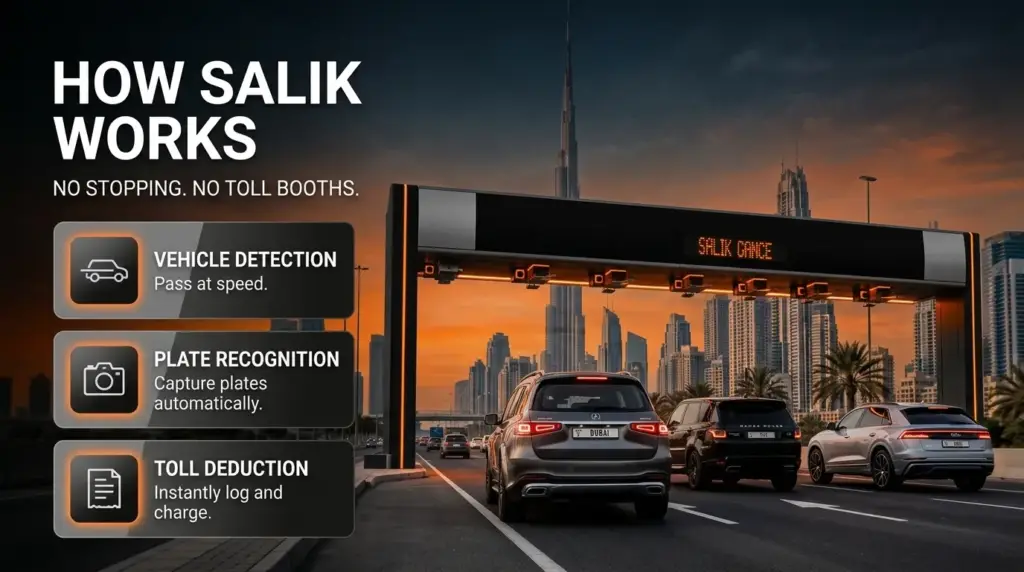
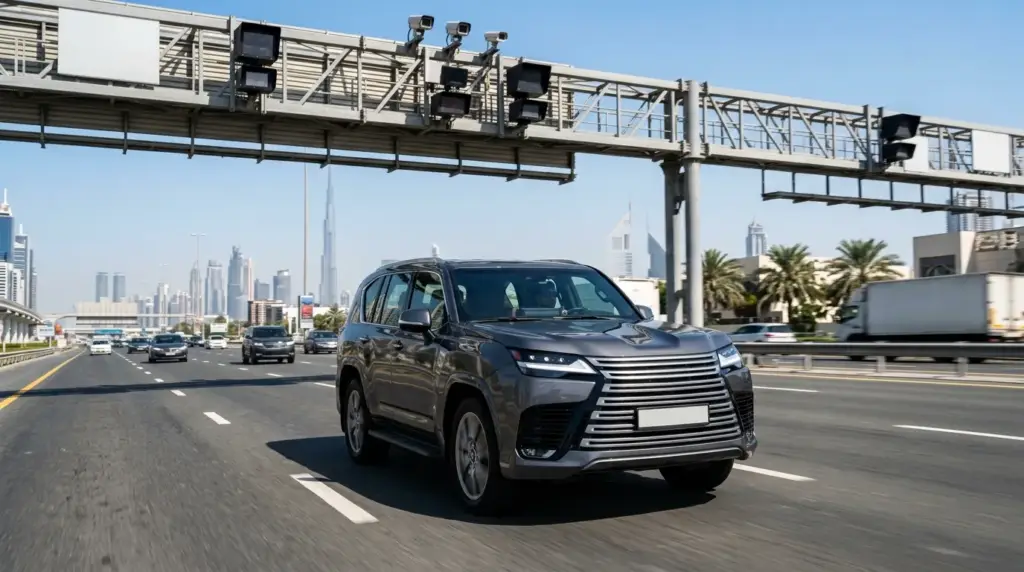
The Salik toll system has two main parts working together: a small electronic sticker on your car, and overhead sensor gantries at each toll gate. The sticker — called the Salik tag — is a passive RFID device, meaning it does not contain its own battery. Instead, it is powered momentarily by the radio signal sent from the toll gate as your car drives underneath. In that split second, the tag transmits its unique ID to the gate, which matches it to your registered account and deducts the toll amount based on the current time-of-day rate.
Each toll gate is also fitted with Automatic Number Plate Recognition (ANPR) cameras that photograph and digitally read your vehicle’s number plate. These cameras serve two purposes: they act as a backup if the vehicle tag is missing, damaged, or incorrectly installed, and they help Salik cross-reference every crossing against the RTA vehicle database to catch violations. So even if you somehow drove through a gate without a working tag, the system would still identify your car by its plate and trigger a fine if the issue was not resolved within the grace period.
How does Salik work from the driver’s seat? You do not do anything differently. You approach the gate at normal highway speed, drive underneath, and keep going. Within minutes, you will get an SMS confirmation showing the gate, the time, and the amount deducted. If your balance is running low, you will receive a separate SMS reminder to recharge before the next trip.
Is Salik Mandatory?
Yes — Salik is mandatory for any vehicle that passes through a Salik toll gate in Dubai. There is no opt-out, no cash alternative, and no way to use these roads without a registered tag. Every car — whether privately owned, rented, company-registered, or even a tourist rental — must have an active vehicle tag affixed to its windscreen before driving under a gate. The system reads tags 24 hours a day, 7 days a week, including weekends and public holidays, with the only variation being the rate charged during different time windows.
That said, certain vehicles are fully exempt from toll charges, including RTA public buses, school buses, ambulances, fire engines, military and police vehicles, and one vehicle per registered Person of Determination. Electric vehicles still have to pay tolls at the standard rates, but they qualify for a free tag from the RTA. Everyone else — including every taxi passenger, since 2013 — pays.
Where Are the Salik Toll Gates Located?
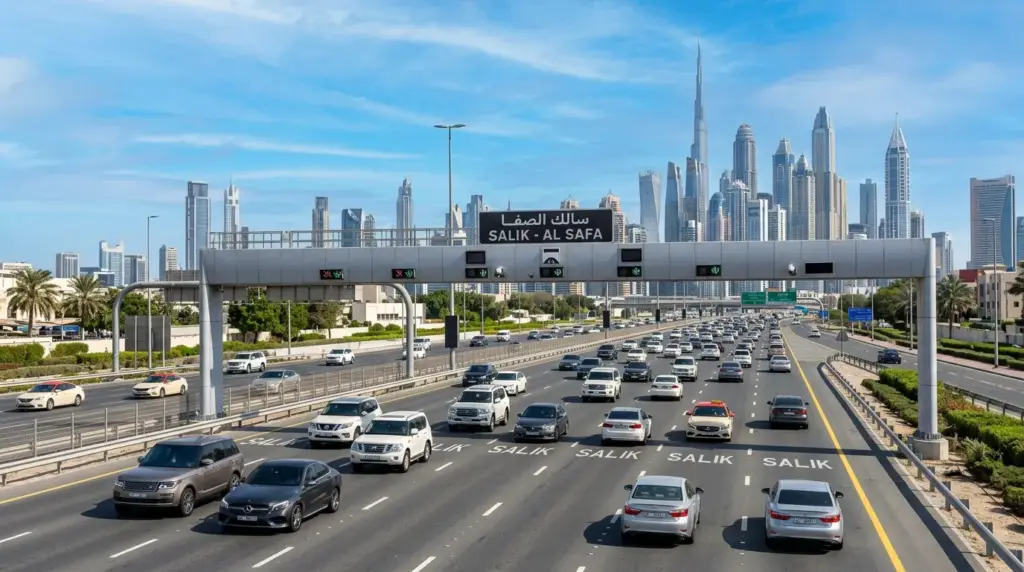
Dubai currently operates ten Salik toll gates, positioned across the city’s busiest corridors. The first eight were added between 2007 and 2018, and two brand-new gates — Al Safa South and Business Bay Crossing — went live in November 2024. The gates are clustered on three main roads: Sheikh Zayed Road (the north-south spine), Al Ittihad Road (the Dubai–Sharjah corridor), and the key creek crossings between Deira and Bur Dubai. If you are new to Dubai Roads, it helps to know that four of the ten gates sit on Sheikh Zayed Road alone, making it the most toll-intensive route in the city.
| # | Gate Name | Road | Key Landmark | Activated |
| 1 | Al Barsha | Sheikh Zayed Road (E11) | Before Mall of the Emirates | 1 July 2007 |
| 2 | Al Garhoud Bridge | Sheikh Rashid Road | Creek crossing, near Dubai Airport | 1 July 2007 |
| 3 | Al Safa North | Sheikh Zayed Road (E11) | Near Al Safa Park / Jumeirah | 9 Sept 2008 |
| 4 | Al Maktoum Bridge | Umm Hurair Road | Creek crossing, Deira ↔ Bur Dubai | 9 Sept 2008 |
| 5 | Al Mamzar North | Al Ittihad Road (E11) | Near Al Mamzar Beach Park | 15 Apr 2013 |
| 6 | Al Mamzar South | Al Ittihad Road (E11) | South of Al Mamzar North | 15 Apr 2013 |
| 7 | Airport Tunnel | Beirut Street | Near Dubai International Airport | 15 Apr 2013 |
| 8 | Jebel Ali | Sheikh Zayed Road (E11) | Near Ibn Battuta Mall | 24 Oct 2018 |
| 9 | Al Safa South | Sheikh Zayed Road (E11) | Between Al Meydan and Umm Al Sheif | Nov 2024 |
| 10 | Business Bay Crossing | Al Khail Road (E44) | Business Bay area | Nov 2024 |
There is also a useful cost-saving rule built into the system. If you pass through both gates in a pair — either Al Mamzar North and Al Mamzar South, or Al Safa North and Al Safa South — in the same direction, within one hour, you are charged only once. The rule applies automatically; you do not need to do anything. The system simply recognises the back-to-back crossing and applies the single-charge logic for that road toll.
Can You Avoid Salik Toll Gates?
Legally, yes — you can plan routes that do not cross any Salik gate. Practically, this often means longer travel times, but the savings add up quickly if you commute daily. Several major Dubai Roads have no Salik gates at all, including Sheikh Mohammed Bin Zayed Road (E311), which runs parallel to Sheikh Zayed Road and bypasses the Al Barsha, Al Safa, and Jebel Ali gates. Al Khail Road (E44) is also mostly toll-free, with the exception of the new Business Bay Crossing gate, and Emirates Road (E611) is fully Salik-free for longer east-west journeys.
You can also enable the “Avoid Tolls” option in Google Maps or Waze, which will actively route you around any Salik gate when feasible. The trade-off is usually 5 to 15 extra minutes per trip, depending on traffic. For tourists and short-term visitors who only need to make a few trips, the simplest cost-saving strategy is to plan non-essential journeys for the toll-free window (1:00 AM to 6:00 AM) or to schedule them on Sundays, when the flat AED 4 rate applies all day.
How Much Does Salik Cost in Dubai?
Salik pricing changed fundamentally on 31 January 2025. The old flat AED 4 per crossing — in place since 2007 — was replaced with a variable pricing model that charges different rates depending on the time of day. The goal was to redistribute traffic away from rush hours by making peak-hour travel more expensive and off-peak travel cheaper. Tolls now range from completely free during the late-night window to AED 6 per crossing during peak hours, with no daily or monthly cap. Every crossing is charged individually, no matter how many gates a vehicle passes through in one day.
Peak Hours
Peak hours are when most commuters are on the road, and Salik charges the highest rate to reflect that demand. There are two peak windows every weekday:
| Day | Peak Window 1 | Peak Window 2 | Rate per Crossing |
| Monday – Saturday | 6:00 AM – 10:00 AM | 4:00 PM – 8:00 PM | AED 6 |
So if you drive from Dubai Marina to Deira via Sheikh Zayed Road during the morning peak — passing through four gates — you will pay 4 × AED 6 = AED 24 one-way, or AED 48 round trip. Across a typical 22-working-day month, that is AED 1,056 just in tolls. Shifting the same commute to off-peak hours drops it to AED 704 per month — a saving of over AED 350.
Off-Peak Hours
Off-peak hours cover the middle of the day and the evening, when traffic is lighter:
| Day | Off-Peak Windows | Rate per Crossing |
| Monday – Saturday | 10:00 AM – 4:00 PM and 8:00 PM – 1:00 AM | AED 4 |
Sundays use a flat AED 4 rate all day, except during the late-night toll-free window. This means Sunday trips that would cost AED 6 per gate on a weekday cost only AED 4 — a 33% saving. For drivers with flexible schedules, shifting non-essential trips to Sundays is one of the easiest ways to cut monthly toll costs without changing the route.
Free Hours
Every Salik gate in Dubai is completely toll-free between 1:00 AM and 6:00 AM, seven days a week:
| Time Window | Rate per Crossing |
| 1:00 AM – 6:00 AM (every day, all 10 gates) | AED 0 (completely free) |
This applies to all ten gates with no exceptions. During Ramadan, the free window shifts to 2:00 AM – 7:00 AM to reflect the different daily rhythm. Late-night airport drop-offs, early-morning commutes, and post-midnight social trips during these hours cost nothing in tolls — useful to keep in mind if you have flexibility in your schedule.
⏰ Need the Exact Salik Schedule?
Our complete guide to Salik Timing in Dubai covers peak and off-peak hours, free timings, weekends, and public holiday schedules to help you plan every trip.
View Salik Timings in Dubai →How to Get a Salik Tag
Every vehicle that drives through a Salik gate must have a registered, activated tag affixed to its windscreen. There are two ways to buy one — online or in person — and the price differs slightly between the two.
If you buy online through salik.ae, the total cost is AED 120. That breaks down as AED 50 for the tag itself, AED 50 in prepaid toll credit, and AED 20 for delivery (VAT included). The tag is auto-activated at the moment of purchase — no separate activation step is needed — and it ships to your UAE address within five working days. Online purchase is only available for vehicles registered in the UAE under private or motorcycle plate categories.
If you buy in person at an authorised petrol station — ENOC, EPPCO, Emarat, or ADNOC — the total cost is AED 100, which includes AED 50 for the tag and AED 50 in prepaid toll credit. You can also purchase through the Careem app. Tags bought in person must be activated separately before you drive through any gate. Vehicles registered outside the UAE must use the in-person route; they cannot purchase online.
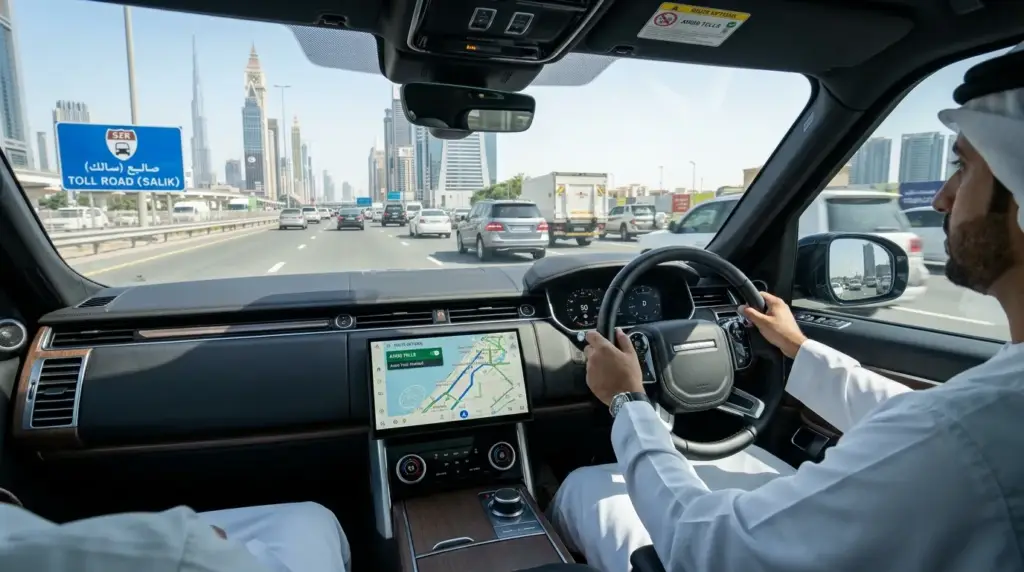
Installation is straightforward but position-sensitive. Clean the inside of the windscreen thoroughly, then stick the tag about 1 cm below the rear-view mirror. If your windscreen has metallic tinting, place the tag on the dotted or lighter area of the tint strip — metallic tint blocks RFID signals and can cause the tag to be unreadable. Press firmly for at least ten seconds to avoid air bubbles, and remember that tags are single-use: once peeled off, the adhesive is destroyed and the tag cannot be re-stuck.
How to Register and Activate a Salik Account
If you bought your tag online, registration happens automatically — your account is created during the purchase flow, and the tag arrives ready to use. If you bought in person, you will need to activate the tag yourself through one of four channels: the Salik website (select “Activate Salik Tag”), the Smart Salik mobile app (iOS and Android), the Dubai Drive app (RTA’s multi-service transport app), or the Salik call centre at 800 SALIK (800 72545), available 24/7.
To complete the activation, you will need three things: your vehicle registration card (mulkiya) — both front and back sides; the Salik tag number printed on the back of the tag itself; and the mobile phone number you want linked to the account. Once activated, your account is ready to receive toll deductions, and you will get SMS notifications for every crossing and for low-balance alerts.
To recharge, the minimum top-up is AED 50 and the maximum is AED 50,000 per transaction, in multiples of 50. You can recharge through the Salik website or Smart Salik app (instant, via debit or credit card), the Dubai Drive app, auto-recharge (recommended for daily commuters — set a threshold and your linked card tops up automatically), SMS to 5959 (a 30 fils operator fee applies), most UAE bank apps, cash deposit machines at Emirates NBD and Dubai Islamic Bank, or by buying a recharge card at any petrol station. The Salik toll system is prepaid, which means your account must always have sufficient balance before you pass through a gate — there is no post-pay option for private account holders.

How Does Salik Work for Rental Cars?
If you are renting a car in Dubai, you do not need to buy your own Salik tag — every registered rental car comes with a valid, activated tag already affixed to its windscreen before it is handed over to you. When you drive through a Salik gate, the toll is deducted automatically from the rental company’s account in real time, and at the end of your rental period, those crossings are added to your final invoice as a separate line item, showing the date, time, and gate for each trip.
Some rental companies charge an additional administrative fee on top of the actual toll amount — this varies widely, so always ask about the Salik billing policy before signing. For a deeper dive into how Salik billing works for rental cars, what admin fees to expect, and what to do if a charge looks wrong, check out our complete guide to Salik for rental cars and tourists. And if you are ready to hit the road, you can browse the full fleet at dubairentalcars.com — your car rental hub in Dubai — or jump straight to our main car rental landing page to compare vehicles and book in minutes.
Common Salik Fines and Penalties
Most Salik fines are not the result of intentional violations — they are the result of preventable mistakes. The two most common violation types are passing a gate with insufficient account balance and passing a gate without any registered tag. Both come with grace periods, but once those grace periods expire, fines escalate quickly.
| Violation | Fine Amount | Notes |
| Insufficient balance (after 5-day grace period) | AED 50 per day | Capped at one violation per day |
| First crossing without tag (after 10-day grace period) | AED 100 | Maximum one violation per day |
| Second crossing without tag | AED 200 | Maximum one violation per day |
| Each subsequent crossing without tag | AED 400 | Maximum one violation per day |
| Tampering with a Salik tag | AED 10,000 | Manipulation, fraud, or misuse |
| Damaging Salik infrastructure | AED 10,000 | Gates, machines, or company assets |
For insufficient balance, you have five working days from the trip date to recharge. If you top up within that window, no fine is imposed — the original toll amount is simply deducted from the new balance. For no-tag violations, you have ten working days from the first trip to purchase, activate, and install a tag. After that, the escalation kicks in: AED 100 for the first violation, AED 200 for the second, and AED 400 for every subsequent one. Unpaid Salik fines will block your vehicle registration renewal with the RTA, so they cannot be ignored. Check for violations through the Salik website, Smart Salik app, Dubai Drive app, Dubai Police app, or any Tasjeel vehicle registration centre.
How to Manage and Reduce Salik Costs
There is no way to use Salik-tolled roads for free during charged hours — but there are several perfectly legal strategies to reduce or even eliminate toll costs on specific trips. The first and most effective is timing. Every gate is toll-free between 1:00 AM and 6:00 AM, so late-night airport drop-offs, early-morning commutes, and post-midnight trips cost nothing. If you have flexibility in your schedule, shifting non-essential journeys to Sundays also saves you 33% per crossing, since the flat Sunday rate is AED 4 instead of AED 6 during weekday peak hours.
The second strategy is routing. Sheikh Mohammed Bin Zayed Road (E311) runs parallel to Sheikh Zayed Road and bypasses the Al Barsha, Al Safa, and Jebel Ali gates entirely. Al Khail Road (E44) is mostly toll-free, and Emirates Road (E611) is fully Salik-free. Use Google Maps or Waze with the “Avoid Tolls” option enabled, and the app will route you around gates when feasible — usually adding 5 to 15 minutes per trip depending on traffic.
The third strategy is the one-hour rule. If your trip forces you through both Al Safa North and Al Safa South (or both Al Mamzar gates) in the same direction, you will only be charged once — provided both crossings happen within one hour. Plan your trip so you do not stop for more than an hour between the two gates, and you save the cost of the second crossing.
Finally, set up auto-recharge on your Salik account. Most fines come from drivers forgetting to top up before a long trip. Auto-recharge links your account to your bank card and tops up automatically when your balance drops below a threshold you set — usually AED 50. It is the single most effective way to never pay an AED 50 insufficient-balance fine again.
FAQ About Salik in Dubai
Salik is Dubai’s electronic, barrier-free toll collection system, launched by the RTA in 2007. It uses RFID tags and ANPR cameras to deduct tolls automatically as vehicles pass under overhead gates.
Tourists do not need to buy a tag — rental cars come pre-equipped. Tolls are billed automatically through the rental company and added to the final invoice.
AED 6 during peak hours (6–10 AM and 4–8 PM, Monday to Saturday), AED 4 during off-peak hours, and completely free between 1:00 AM and 6:00 AM daily.
There are 10 Salik toll gates across Dubai, including four on Sheikh Zayed Road alone. Two new gates were added in November 2024.
No — Sundays use a flat AED 4 rate per crossing all day, except during the 1:00 AM to 6:00 AM toll-free window, which remains completely free.
No. The previous AED 24 daily cap was removed in July 2013. Every crossing is charged individually, regardless of how many gates you pass through in one day.
You can buy online at salik.ae for AED 120 (delivered within 5 working days) or in person at ENOC, EPPCO, Emarat, and ADNOC petrol stations for AED 100.
Log in to your account on salik.ae, open the Smart Salik mobile app, use the Dubai Drive app, or call 800 SALIK (800 72545) — the balance updates instantly after each crossing.
A: No. Abu Dhabi uses a separate system called Darb, with different tags, different gates, and different pricing rules. Salik tags are not valid at Darb gates.